CST428 · Blockchain Technologies · ← all papers
Answer Key - CST428 Blockchain Technologies
Every answer keyed to its KTU mark distribution. Click any question to expand — search is instant.
Answer Key - CST428 Blockchain Technologies
Examination: June 2023
Course Code: CST428
Course Name: Blockchain Technologies
Total Marks: 100
Duration: 3 Hours
Modules Covered: All (1-5)
PART A
Answer all questions, each carries 3 marks.
Question 1: Compare Symmetric and Asymmetric Key Cryptography (3 marks)
Symmetric Cryptography uses the same key for both encryption and decryption, while Asymmetric Cryptography uses a pair of keys (public and private).
Key Differences:
| Feature | Symmetric Cryptography | Asymmetric Cryptography |
|---|---|---|
| Keys | Single shared secret key | Public-private key pair |
| Speed | Faster (simple operations) | Slower (complex mathematical operations) |
| Key Distribution | Difficult (secure channel needed) | Easier (public key can be shared openly) |
| Use Cases | Bulk data encryption | Key exchange, digital signatures |
| Examples | AES, DES, 3DES | RSA, ECC, ElGamal |
| Key Length | Shorter keys (128-256 bits) | Longer keys (2048-4096 bits) |
Question 2: How can secure hash functions strengthen blockchain technology? (3 marks)
Secure hash functions are cryptographic algorithms that take input data of any size and produce a fixed-size output (hash/digest). They strengthen blockchain technology in several critical ways:
Applications in Blockchain:
-
Immutability: Each block contains the hash of the previous block, creating an immutable chain. Any modification to a block changes its hash, breaking the chain and making tampering detectable.
-
Data Integrity: Hash functions ensure transaction data integrity. The Merkle root (hash of all transactions) in the block header allows quick verification of transaction inclusion and integrity.
-
Consensus Mechanism (PoW): Mining requires finding a nonce that produces a hash with specific characteristics (e.g., leading zeros), providing computational proof of work.
-
Digital Signatures: Hash functions are used in creating and verifying digital signatures for transactions, ensuring authentication and non-repudiation.
-
Block Identification: Each block is uniquely identified by its hash, serving as a fingerprint for the entire block content.
Question 3: What are the different components of a block header? (3 marks)
A block header contains metadata about a block in the blockchain. The main components are:
Core Components:
-
Version Number: Indicates the version of the blockchain protocol being used.
-
Previous Block Hash: Hash of the previous block's header, creating the chain linkage and ensuring immutability.
-
Merkle Root: Root hash of the Merkle tree containing all transactions in the block, allowing efficient verification of transaction inclusion.
-
Timestamp: The approximate creation time of the block (Unix epoch time).
-
Difficulty Target (Bits): Represents the difficulty level for the Proof of Work puzzle that miners must solve.
-
Nonce: A random number that miners modify to find a valid block hash that meets the difficulty target.
Additional Components (in some blockchains):
- Block height/number
- State root (in Ethereum)
- Transaction count
Question 4: Explain the ecosystem of decentralisation with respect to blockchain (3 marks)
The decentralization ecosystem in blockchain refers to the distributed architecture where control, decision-making, and data storage are spread across multiple nodes rather than centralized in a single authority.
Key Components of Decentralization Ecosystem:
-
Distributed Network: Multiple nodes (computers) participate in the network, each maintaining a copy of the blockchain ledger, eliminating single points of failure.
-
Peer-to-Peer Architecture: Nodes communicate directly with each other without intermediaries, enabling trustless transactions between participants.
-
Consensus Mechanism: Distributed agreement protocols (PoW, PoS, PBFT) allow nodes to collectively validate transactions and maintain consistency without central coordination.
-
Decentralized Governance: Decision-making power is distributed among stakeholders through voting mechanisms or protocol rules rather than centralized management.
-
Data Decentralization: Transaction data and state are replicated across all nodes, preventing data monopoly and ensuring transparency and availability.
Benefits: Enhanced security, censorship resistance, transparency, fault tolerance, and elimination of single points of control or failure.
Question 5: What are the different steps involved in the process of a Bitcoin transaction? (3 marks)
A Bitcoin transaction goes through several steps from initiation to confirmation:
Transaction Lifecycle Steps:
-
Transaction Creation: The sender creates a transaction using their wallet, specifying the recipient's address, amount to send, and transaction fee. The transaction references previous unspent outputs (UTXOs) as inputs.
-
Digital Signature: The sender signs the transaction with their private key, proving ownership of the funds and authorizing the transfer.
-
Broadcasting: The signed transaction is broadcast to the Bitcoin peer-to-peer network, where it propagates to all connected nodes.
-
Validation: Nodes validate the transaction by checking:
- Valid digital signatures
- Sufficient input funds
- No double-spending
- Correct script execution
-
Mempool Storage: Valid transactions are stored in the memory pool (mempool) awaiting inclusion in a block.
-
Mining/Block Inclusion: Miners select transactions from the mempool (typically prioritizing higher fees) and include them in a new block candidate.
-
Proof of Work: Miners compete to solve the cryptographic puzzle (finding valid nonce) to add the block to the blockchain.
-
Confirmation: Once the block is mined and added to the blockchain, the transaction receives its first confirmation. Additional confirmations occur as new blocks are added (typically 6 confirmations considered secure).
Question 6: What is mining in blockchain? (3 marks)
Mining is the process by which new blocks are created and added to a blockchain, primarily used in Proof of Work (PoW) consensus mechanisms like Bitcoin.
Key Aspects of Mining:
-
Transaction Validation: Miners collect pending transactions from the mempool, verify their validity, and bundle them into a block candidate.
-
Proof of Work Computation: Miners compete to solve a computationally intensive cryptographic puzzle by finding a nonce value that, when hashed with the block header, produces a hash meeting the difficulty target (typically with a specific number of leading zeros).
-
Block Addition: The first miner to find a valid solution broadcasts the block to the network. Other nodes verify the solution and add the block to their copy of the blockchain.
-
Rewards: Successful miners receive rewards consisting of:
- Block Reward: Newly created cryptocurrency (e.g., 6.25 BTC in Bitcoin as of 2023)
- Transaction Fees: Fees paid by users for transaction processing
Purpose: Mining secures the network through computational work, validates transactions in a decentralized manner, and controls the creation of new cryptocurrency.
Question 7: What are smart contracts? (3 marks)
Smart contracts are self-executing programs stored on a blockchain that automatically execute predefined actions when specific conditions are met, without requiring intermediaries.
Key Characteristics:
-
Self-Executing: Code automatically executes when triggering conditions are satisfied, eliminating the need for manual intervention or third-party enforcement.
-
Immutable: Once deployed on the blockchain, smart contracts cannot be modified, ensuring the terms remain unchanged and tamper-proof.
-
Deterministic: Given the same inputs, smart contracts always produce the same outputs, ensuring predictable behavior.
-
Distributed: Smart contracts run on all nodes in the blockchain network, ensuring transparency and preventing single points of failure.
Components:
- Code Logic: Business rules and conditions written in languages like Solidity (Ethereum)
- State Variables: Data stored on the blockchain
- Functions: Methods that can be called to execute contract logic
- Events: Notifications emitted when specific actions occur
Use Cases: Digital agreements, decentralized finance (DeFi), token creation, supply chain tracking, voting systems, and automated escrow services.
Question 8: List and explain the different types of oracles (3 marks)
Oracles are third-party services that provide external real-world data to smart contracts on the blockchain, enabling them to interact with off-chain information.
Types of Oracles:
-
Software Oracles: Provide data from online sources such as web APIs, databases, and servers. Examples include price feeds (cryptocurrency prices), weather data, and flight status information.
-
Hardware Oracles: Obtain data from physical devices and sensors in the real world, such as IoT sensors, barcode scanners, RFID readers, and temperature sensors used in supply chain monitoring.
-
Inbound Oracles: Deliver external data into smart contracts on the blockchain (e.g., bringing stock prices to a DeFi application).
-
Outbound Oracles: Send data from smart contracts to external systems, triggering real-world actions (e.g., sending payment instructions to a bank).
-
Consensus-Based Oracles: Aggregate data from multiple sources and use consensus mechanisms (like Chainlink) to determine the most accurate value, reducing single points of failure and manipulation.
-
Human Oracles: Individuals with specialized knowledge who verify and input data manually, often used for subjective information that requires expert judgment.
Question 9: Illustrate the role of EVM in Ethereum network (3 marks)
The Ethereum Virtual Machine (EVM) is a runtime environment that executes smart contracts on the Ethereum blockchain, functioning as the decentralized computer that powers the network.
Key Roles of EVM:
-
Smart Contract Execution: The EVM executes bytecode compiled from Solidity or other high-level languages, processing the logic defined in smart contracts deterministically across all nodes.
-
State Management: The EVM maintains and updates the Ethereum world state, which includes account balances, smart contract code, and storage data, ensuring consistency across the network.
-
Isolation and Security: Each smart contract runs in an isolated sandbox environment, preventing malicious contracts from accessing or corrupting other contracts or the underlying system.
-
Gas Mechanism: The EVM implements the gas system, which measures computational effort and limits execution to prevent infinite loops and spam, with users paying for computation in Ether.
-
Platform Independence: The EVM provides a platform-agnostic execution environment, allowing the same bytecode to run identically on any device running an Ethereum node, regardless of hardware or operating system.
Architecture: The EVM is a stack-based machine with 256-bit word size, providing operations for arithmetic, logical computations, cryptographic functions, and blockchain-specific operations.
Question 10: List the various components in Ethereum blockchain (3 marks)
The Ethereum blockchain consists of several interconnected components that together create a decentralized platform for smart contracts and applications:
Core Components:
-
Accounts:
- Externally Owned Accounts (EOA): Controlled by private keys, used by individuals to send transactions
- Contract Accounts: Controlled by smart contract code, store contract logic and state
-
Ether (ETH): The native cryptocurrency used for transaction fees (gas), value transfer, and incentivizing network participants.
-
Smart Contracts: Self-executing code deployed on the blockchain that defines application logic and business rules.
-
Ethereum Virtual Machine (EVM): The runtime environment that executes smart contract bytecode deterministically across all nodes.
-
Transactions: Signed messages that transfer value or trigger smart contract functions, changing the state of the blockchain.
-
Blocks: Containers that bundle multiple transactions together, linked chronologically through block headers containing previous block hashes.
-
Gas: The unit measuring computational effort required for operations, paid in Ether to prevent spam and allocate network resources.
-
Nodes: Computers running Ethereum client software that validate transactions, execute smart contracts, and maintain copies of the blockchain.
-
World State: The mapping of all account addresses to their states (balances, code, storage), represented using a Merkle Patricia Tree.
-
Consensus Mechanism: Protocol for achieving agreement on the blockchain state (originally Proof of Work, now Proof of Stake after "The Merge").
PART B
Answer any one full question from each module, each carries 14 marks.
Module I - Fundamentals of Cryptography — #### Question 11
Question 11
(a) What is state matrix in AES? Explain the different steps involved in conversion of initial state matrix to output state matrix (8 marks)
State Matrix in AES:
The state matrix (or state array) in AES (Advanced Encryption Standard) is a 4×4 array of bytes that represents the intermediate data during encryption/decryption. The 128-bit input block is organized into this matrix in column-major order, where each cell contains one byte (8 bits).
State Matrix Structure:
    Column 0  Column 1  Column 2  Column 3
    ┌─────────────────────────────────────┐
Row 0│  s0,0      s0,1      s0,2      s0,3  │
Row 1│  s1,0      s1,1      s1,2      s1,3  │
Row 2│  s2,0      s2,1      s2,2      s2,3  │
Row 3│  s3,0      s3,1      s3,2      s3,3  │
    └─────────────────────────────────────┘
AES Transformation Steps (Converting Initial State to Output State):
AES encryption consists of multiple rounds (10 rounds for AES-128, 12 for AES-192, 14 for AES-256). Each round (except the last) applies four transformations to the state matrix:
1. SubBytes (Byte Substitution):
- Each byte in the state matrix is replaced with a corresponding byte from the S-box (substitution box)
- The S-box is a 16×16 lookup table that provides non-linear transformation
- This step provides confusion by creating a complex relationship between plaintext and ciphertext
- Example: If s0,0 = 0x19, it might be replaced with S-box[0x19] = 0xD4
2. ShiftRows (Row Shifting):
- Each row of the state matrix is cyclically shifted to the left by different offsets:
- Row 0: No shift (shift by 0 positions)
- Row 1: Shift left by 1 position
- Row 2: Shift left by 2 positions
- Row 3: Shift left by 3 positions
- This provides diffusion by spreading bytes across different columns
Before ShiftRows:          After ShiftRows:
s0,0  s0,1  s0,2  s0,3    s0,0  s0,1  s0,2  s0,3
s1,0  s1,1  s1,2  s1,3 →  s1,1  s1,2  s1,3  s1,0
s2,0  s2,1  s2,2  s2,3    s2,2  s2,3  s2,0  s2,1
s3,0  s3,1  s3,2  s3,3    s3,3  s3,0  s3,1  s3,2
3. MixColumns (Column Mixing):
- Each column of the state matrix is treated as a polynomial and multiplied with a fixed polynomial modulo x⁴ + 1
- This is implemented using Galois Field (GF(2⁸)) arithmetic
- Each column is transformed independently using matrix multiplication
- Provides further diffusion by mixing bytes within each column
- Note: This step is omitted in the final round
Matrix Multiplication:
┌───┐   ┌───────────┐   ┌───┐
│s'0│   │02 03 01 01│   │s0 │
│s'1│ = │01 02 03 01│ × │s1 │
│s'2│   │01 01 02 03│   │s2 │
│s'3│   │03 01 01 02│   │s3 │
└───┘   └───────────┘   └───┘
4. AddRoundKey (Key Addition):
- Each byte of the state matrix is XORed with the corresponding byte of the round key
- The round key is derived from the original cipher key using a key expansion algorithm
- This introduces the secret key into the encryption process
- Operation: state[i,j] = state[i,j] ⊕ roundKey[i,j]
Complete AES Encryption Process:
flowchart TD
    A[Plaintext 128-bit] --> B[Initial State Matrix 4×4]
    B --> C[AddRoundKey - Round 0]
    C --> D{Round 1-9}
    D --> E[SubBytes]
    E --> F[ShiftRows]
    F --> G[MixColumns]
    G --> H[AddRoundKey]
    H --> I{More Rounds?}
    I -->|Yes| D
    I -->|No| J[Final Round 10]
    J --> K[SubBytes]
    K --> L[ShiftRows]
    L --> M[AddRoundKey - No MixColumns]
    M --> N[Ciphertext 128-bit]
Summary:
- Initial state: Plaintext arranged in 4×4 matrix
- 10 rounds of transformations (for AES-128)
- Each round applies: SubBytes → ShiftRows → MixColumns → AddRoundKey
- Final round omits MixColumns
- Output state: Ciphertext extracted from final state matrix
(b) Perform encryption and decryption using RSA for p=7, q=11, e=17 and M=25 (6 marks)
Given:
- p = 7, q = 11 (two prime numbers)
- e = 17 (public exponent)
- M = 25 (plaintext message)
RSA Encryption and Decryption:
Step 1: Calculate n
n = p × q
n = 7 × 11
n = 77
Step 2: Calculate φ(n) (Euler's totient function)
φ(n) = (p - 1) × (q - 1)
φ(n) = (7 - 1) × (11 - 1)
φ(n) = 6 × 10
φ(n) = 60
Step 3: Verify e is valid
gcd(e, φ(n)) = gcd(17, 60)
Using Euclidean algorithm:
60 = 3 × 17 + 9
17 = 1 × 9 + 8
9 = 1 × 8 + 1
8 = 8 × 1 + 0

gcd(17, 60) = 1 ✓
e = 17 is valid since it is coprime to φ(n).
Public Key: (e, n) = (17, 77)
Step 4: Calculate d (private key exponent)
Find d such that: d × e ≡ 1 (mod φ(n))
d × 17 ≡ 1 (mod 60)
Using Extended Euclidean Algorithm:
60 = 3 × 17 + 9
17 = 1 × 9 + 8
9 = 1 × 8 + 1

Back substitution:
1 = 9 - 1 × 8
1 = 9 - 1 × (17 - 1 × 9)
1 = 2 × 9 - 1 × 17
1 = 2 × (60 - 3 × 17) - 1 × 17
1 = 2 × 60 - 6 × 17 - 1 × 17
1 = 2 × 60 - 7 × 17

Therefore: -7 × 17 ≡ 1 (mod 60)
d = -7 + 60 = 53
Verification: 53 × 17 = 901 = 15 × 60 + 1 ✓
Private Key: (d, n) = (53, 77)
Step 5: ENCRYPTION
Ciphertext C = M^e mod n
C = 25^17 mod 77
Using successive squaring (modular exponentiation):
17 = 16 + 1 = 2^4 + 2^0

25^1 mod 77 = 25
25^2 mod 77 = 625 mod 77 = 625 - 8×77 = 625 - 616 = 9
25^4 mod 77 = 9^2 mod 77 = 81 mod 77 = 4
25^8 mod 77 = 4^2 mod 77 = 16
25^16 mod 77 = 16^2 mod 77 = 256 mod 77 = 256 - 3×77 = 256 - 231 = 25

C = 25^17 mod 77 = (25^16 × 25^1) mod 77
C = (25 × 25) mod 77
C = 625 mod 77
C = 9
Ciphertext: C = 9
Step 6: DECRYPTION
Plaintext M = C^d mod n
M = 9^53 mod 77
Using successive squaring:
53 = 32 + 16 + 4 + 1 = 2^5 + 2^4 + 2^2 + 2^0

9^1 mod 77 = 9
9^2 mod 77 = 81 mod 77 = 4
9^4 mod 77 = 4^2 mod 77 = 16
9^8 mod 77 = 16^2 mod 77 = 256 mod 77 = 256 - 3×77 = 25
9^16 mod 77 = 25^2 mod 77 = 625 mod 77 = 9
9^32 mod 77 = 9^2 mod 77 = 4

M = (9^32 × 9^16 × 9^4 × 9^1) mod 77
M = (4 × 9 × 16 × 9) mod 77
M = (36 × 144) mod 77
M = (36 mod 77) × (144 mod 77) mod 77
M = 36 × 67 mod 77
M = 2412 mod 77
M = 2412 - 31×77 = 2412 - 2387 = 25
Decrypted Message: M = 25 ✓ (Matches original plaintext)
Summary:
- Public Key: (e=17, n=77)
- Private Key: (d=53, n=77)
- Plaintext: M = 25
- Ciphertext: C = 9
- Decrypted: M = 25 ✓ Verified
Question 12
(a) Explain SHA-256 algorithm. With neat diagram explain the compression function used in SHA-256 (7 marks)
SHA-256 (Secure Hash Algorithm 256-bit):
SHA-256 is a cryptographic hash function that produces a 256-bit (32-byte) hash value from input data of any length. It belongs to the SHA-2 family designed by the NSA and is widely used in blockchain technology, digital signatures, and data integrity verification.
Properties of SHA-256:
- Deterministic: Same input always produces same output
- Fixed Output: Always produces 256-bit hash regardless of input size
- One-way Function: Computationally infeasible to reverse
- Avalanche Effect: Small change in input drastically changes output
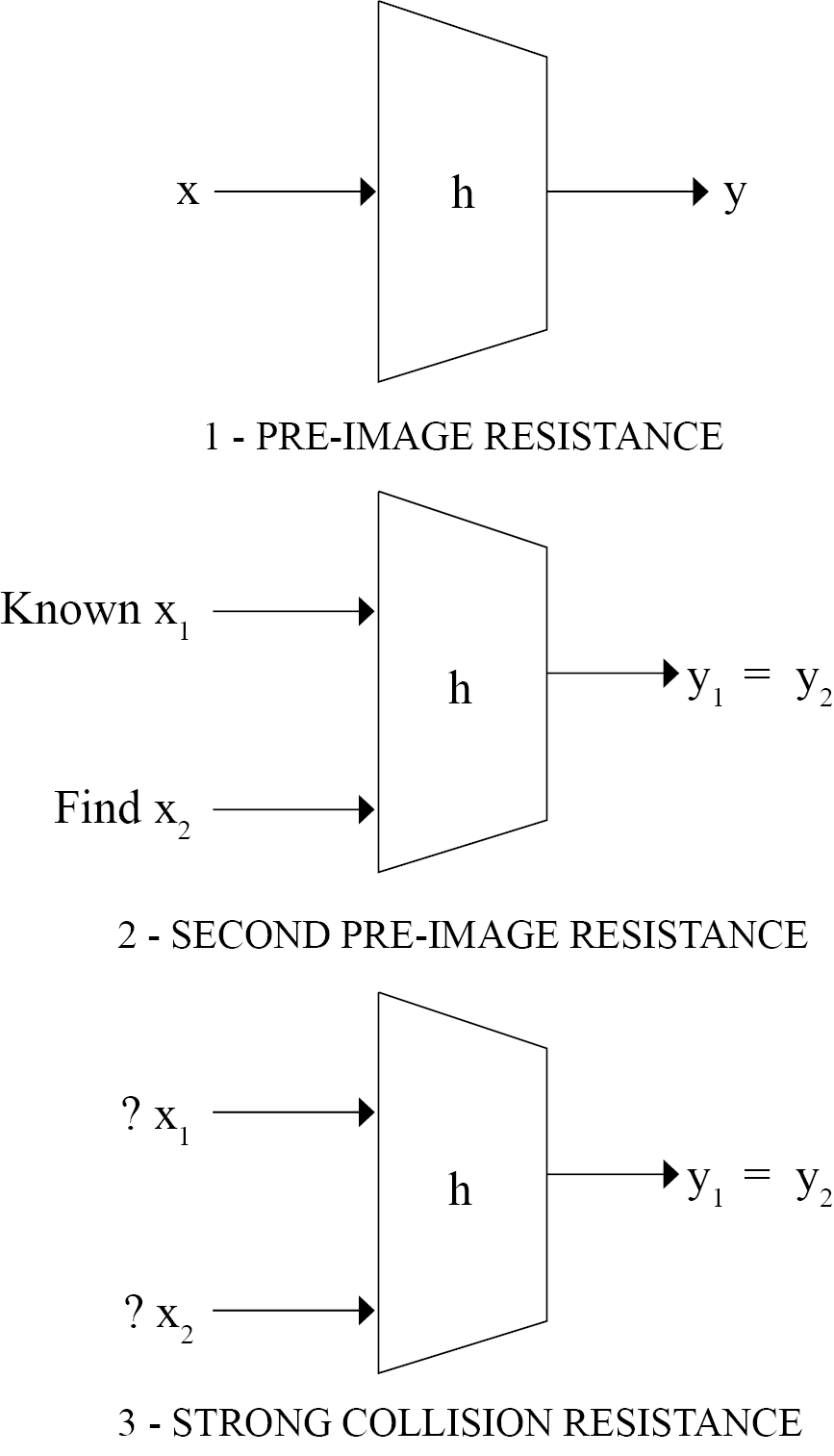
- Collision Resistant: Extremely difficult to find two inputs with same hash
SHA-256 Algorithm Overview:
Step 1: Message Padding
- Append a single '1' bit to the message
- Add '0' bits until message length ≡ 448 (mod 512)
- Append 64-bit representation of original message length
- Result: Message length is multiple of 512 bits
Step 2: Parsing
- Divide padded message into 512-bit blocks (M₁, M₂, ..., Mₙ)
- Each block is processed sequentially
Step 3: Initialize Hash Values
H₀ = 0x6a09e667    H₄ = 0x510e527f
H₁ = 0xbb67ae85    H₅ = 0x9b05688c
H₂ = 0x3c6ef372    H₆ = 0x1f83d9ab
H₃ = 0xa54ff53a    H₇ = 0x5be0cd19
(These are first 32 bits of fractional parts of square roots of first 8 primes)
Step 4: Process Each 512-bit Block
For each message block:
- Prepare message schedule (expand 512 bits to 2048 bits)
- Initialize working variables with current hash values
- Perform 64 rounds of compression function
- Add compressed values to hash values
SHA-256 Compression Function:
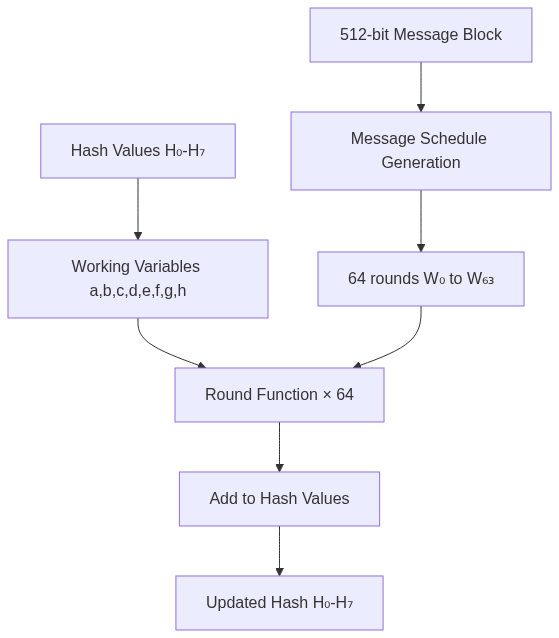
Detailed Compression Function Diagram:
Message Block (512 bits)
         |
         v
┌─────────────────────────────────────────┐
│   Message Schedule Generation           │
│   W₀, W₁, ..., W₁₅ (first 16 words)    │
│   W₁₆ to W₆₃ calculated using:         │
│   Wₜ = σ₁(Wₜ₋₂) + Wₜ₋₇ +              │
│        σ₀(Wₜ₋₁₅) + Wₜ₋₁₆              │
└─────────────────────────────────────────┘
         |
         v
┌─────────────────────────────────────────┐
│  Initialize: a=H₀, b=H₁, c=H₂, d=H₃,   │
│             e=H₄, f=H₅, g=H₆, h=H₇     │
└─────────────────────────────────────────┘
         |
         v
    For t = 0 to 63:
    ┌───────────────────────────┐
    │  T₁ = h + Σ₁(e) + Ch(e,f,g)│
    │       + Kₜ + Wₜ            │
    │  T₂ = Σ₀(a) + Maj(a,b,c)   │
    │                            │
    │  h = g                     │
    │  g = f                     │
    │  f = e                     │
    │  e = d + T₁                │
    │  d = c                     │
    │  c = b                     │
    │  b = a                     │
    │  a = T₁ + T₂               │
    └───────────────────────────┘
         |
         v
┌─────────────────────────────────────────┐
│   Add to Hash Values:                   │
│   H₀ = H₀ + a, H₁ = H₁ + b             │
│   H₂ = H₂ + c, H₃ = H₃ + d             │
│   H₄ = H₄ + e, H₅ = H₅ + f             │
│   H₆ = H₆ + g, H₇ = H₇ + h             │
└─────────────────────────────────────────┘
Compression Function Components:
1. Logical Functions:
- Ch(e,f,g) = (e AND f) XOR (NOT e AND g) - "Choose" function
- Maj(a,b,c) = (a AND b) XOR (a AND c) XOR (b AND c) - "Majority" function
2. Rotation Functions:
- Σ₀(a) = ROTR²(a) ⊕ ROTR¹³(a) ⊕ ROTR²²(a)
- Σ₁(e) = ROTR⁶(e) ⊕ ROTR¹¹(e) ⊕ ROTR²⁵(e)
- σ₀(x) = ROTR⁷(x) ⊕ ROTR¹⁸(x) ⊕ SHR³(x)
- σ₁(x) = ROTR¹⁷(x) ⊕ ROTR¹⁹(x) ⊕ SHR¹⁰(x)
3. Constants (Kₜ):
- 64 constant values (K₀ to K₆₃)
- Derived from first 32 bits of fractional parts of cube roots of first 64 primes
Round Operation Flow:
        Wₜ    Kₜ
         |     |
    ┌────┴─────┴────┐
    │               │
  ┌─┴─┐  ┌──┐  ┌──┐│
  │ h │  │Σ₁│  │Ch││
  └─┬─┘  └─┬┘  └─┬┘│
    └──┬───┴────┴─┘│
       │    T₁      │
   ┌───┴────┐       │
   │   +    │◄──────┘
   └───┬────┘
       │
  ┌────┴────┐  ┌──┐  ┌───┐
  │    a    │  │Σ₀│  │Maj│
  └────┬────┘  └─┬┘  └─┬─┘
       └────┬────┴────┴──┘
            │    T₂
       ┌────┴────┐
       │  T₁+T₂  │ → new a
       └─────────┘
Step 5: Final Hash
After processing all blocks, concatenate H₀ || H₁ || H₂ || H₃ || H₄ || H₅ || H₆ || H₇ to produce the final 256-bit hash.
Example:
Input: "hello"
SHA-256: 2cf24dba5fb0a30e26e83b2ac5b9e29e1b161e5c1fa7425e73043362938b9824
Applications in Blockchain:
- Bitcoin mining (finding block hash with specific pattern)
- Transaction integrity verification
- Merkle tree construction
- Block identification
(b) How can Merkle tree increase the security of blockchain? (7 marks)
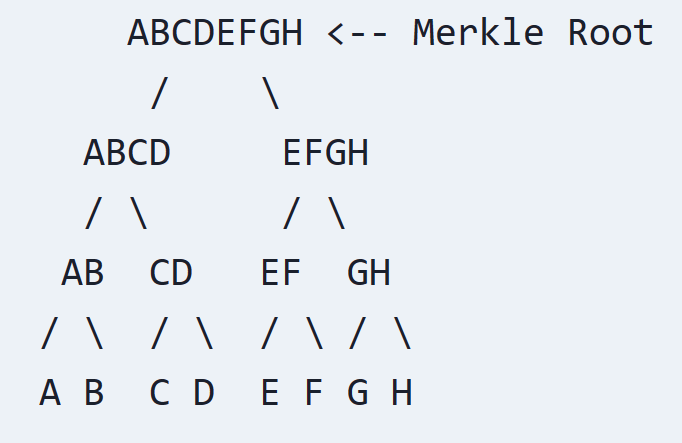
Merkle Tree (Hash Tree):
A Merkle tree is a binary tree data structure where each leaf node contains the hash of a data block (transaction), and each non-leaf node contains the cryptographic hash of its child nodes. The root of the tree, called the Merkle root, represents a single hash that summarizes all transactions.
Structure of Merkle Tree:
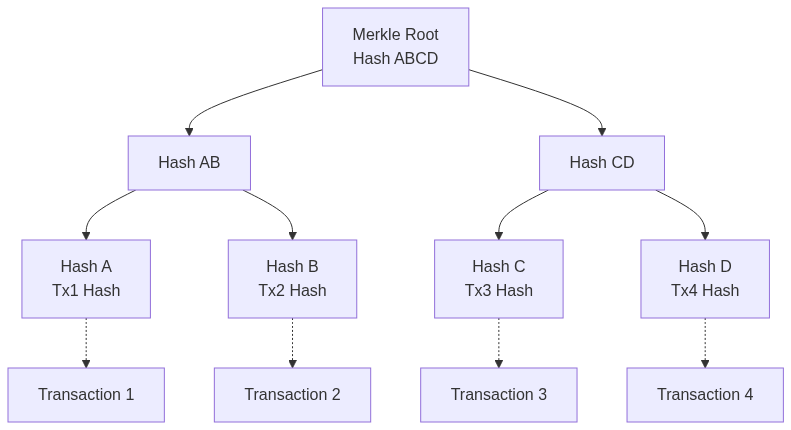
Construction Process:
Transactions:     Tx1      Tx2      Tx3      Tx4

Hash Level 1:    H(Tx1)  H(Tx2)  H(Tx3)  H(Tx4)
                   HA       HB       HC       HD

Hash Level 2:     H(HA||HB)        H(HC||HD)
                    HAB               HCD

Merkle Root:      H(HAB||HCD)
                     HABCD
How Merkle Trees Increase Blockchain Security:
1. Data Integrity Verification:
- The Merkle root in the block header represents all transactions in the block
- Any modification to a single transaction changes its hash, which propagates up the tree, changing the Merkle root
- This makes tampering immediately detectable without checking every transaction
- Example: If Tx2 is modified, Hash B changes → Hash AB changes → Merkle Root changes → Block becomes invalid
2. Efficient Transaction Verification (SPV - Simplified Payment Verification):
- Light clients can verify a transaction's inclusion without downloading the entire blockchain
- Only the Merkle proof (authentication path) is needed, not all transactions
- Verification Process:
- To verify Tx1, client needs: Hash B, Hash CD, and Merkle Root
- Compute: H(H(Hash A || Hash B) || Hash CD) and compare with Merkle Root
- Efficiency: For n transactions, verification requires only log₂(n) hashes instead of n transactions
Example Merkle Proof:
To verify Tx1 in a tree with 8 transactions:
Required hashes: HB, HCD, HEFGH (3 hashes)
vs. downloading all 8 transactions
Proof size: O(log n) vs O(n)
3. Immutability Enhancement:
- Merkle root is stored in the block header, which is hashed to create the block's unique identifier
- Changing any transaction requires:
- Recalculating the Merkle root
- Recalculating the block hash
- Recalculating all subsequent block hashes (due to chain linkage)
- Redoing Proof of Work for all affected blocks
- This computational burden makes historical data practically immutable
4. Tamper Detection:
- Quick detection of data corruption or malicious modification
- No need to compare entire transaction sets
- Simply compare Merkle roots - if different, tampering occurred
- Granular Detection: Can identify exactly which transaction was modified by traversing the tree
5. Efficient Synchronization:
- Nodes can quickly verify received blocks by checking Merkle root
- Newly joining nodes can verify blockchain history efficiently
- Reduces bandwidth and storage requirements for verification
6. Scalability for Light Clients:
- Mobile wallets and lightweight nodes can participate without storing full blockchain
- SPV clients store only block headers (~80 bytes each) instead of full blocks (can be MBs)
- Can verify payments using Merkle proofs with minimal data
- Example: Bitcoin header = 80 bytes, but block can be > 1 MB
7. Partial Data Verification:
- Can prove inclusion or non-inclusion of specific transactions
- Useful for:
- Payment verification
- Audit trails
- Compliance checks
- Without revealing all transaction data (privacy preservation)
8. Consistency Checking:
- Different nodes can quickly verify they have the same transaction set
- Compare Merkle roots instead of comparing individual transactions
- Facilitates consensus and network synchronization
Merkle Proof Example:
To verify Transaction 2 exists in a block with 4 transactions:
Provided Proof: {Hash A, Hash CD, Merkle Root}

Verification Steps:
1. Calculate Hash B = H(Transaction 2)
2. Calculate Hash AB = H(Hash A || Hash B)
3. Calculate Calculated Root = H(Hash AB || Hash CD)
4. Compare: Calculated Root == Merkle Root
   If equal → Transaction 2 is in block ✓
   If different → Transaction 2 not in block or tampered ✗
Security Benefits Summary:
| Security Aspect | How Merkle Tree Helps |
|---|---|
| Data Integrity | Any change propagates to root, immediately detectable |
| Efficiency | O(log n) verification vs O(n) for all transactions |
| Immutability | Changes require recalculating entire tree and subsequent blocks |
| Scalability | Light clients can verify with minimal data |
| Tamper Detection | Quick identification of modified transactions |
| Storage | Headers only needed for SPV (80 bytes vs MB blocks) |
| Bandwidth | Proofs are small (few hashes vs entire transaction set) |
Real-World Application in Bitcoin:
- Bitcoin block header (80 bytes) contains Merkle root
- Blocks can contain thousands of transactions (> 1 MB)
- SPV wallets verify payments using ~500 bytes of proof data
- Efficiency gain: 99.95% reduction in data needed for verification
Conclusion:
Merkle trees are fundamental to blockchain security, enabling efficient verification, maintaining data integrity, and allowing lightweight participation while preserving the trustless and decentralized nature of blockchain systems.
Module II - Fundamentals of Blockchain Technology — #### Question 13
Question 13
(a) With neat diagram explain the working of blockchain (7 marks)
Blockchain Working Mechanism:
Blockchain is a distributed ledger technology that maintains a continuously growing list of records (blocks) linked together using cryptography. Each block contains transaction data, a timestamp, and a cryptographic hash of the previous block, creating an immutable chain.
How Blockchain Works:
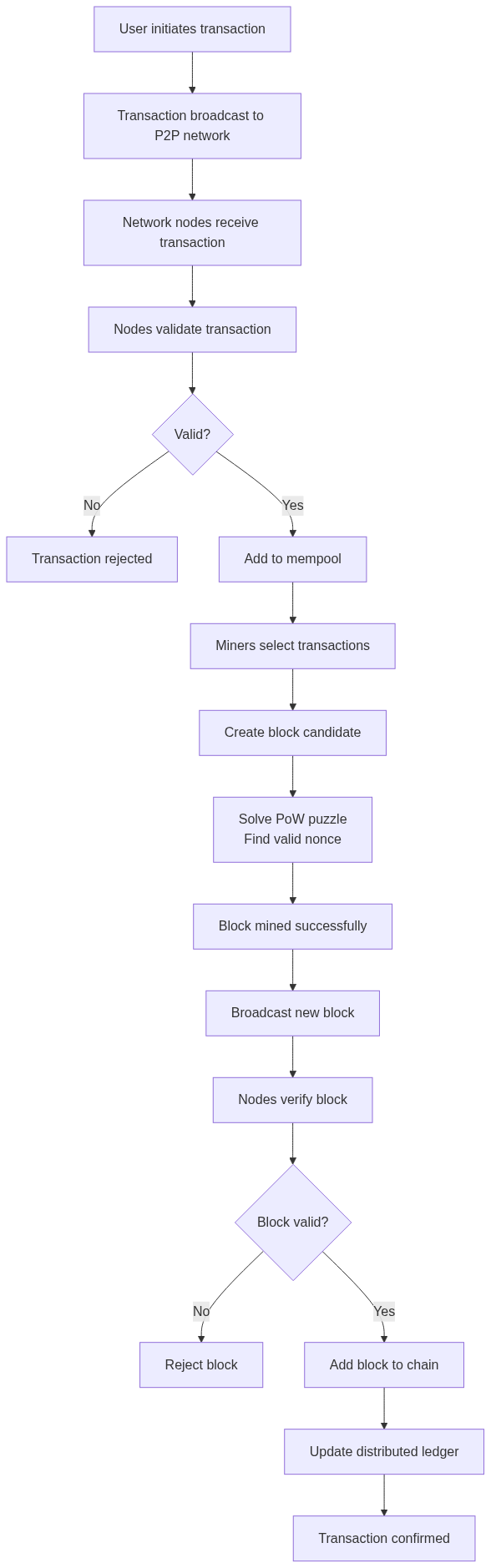
Step-by-Step Working Process:
1. Transaction Initiation:
- User creates a transaction (e.g., sending cryptocurrency)
- Transaction includes sender address, receiver address, amount, and timestamp
- User signs transaction with their private key for authentication
2. Broadcasting:
- Signed transaction is broadcast to all nodes in the peer-to-peer network
- Transaction propagates through the network using gossip protocol
3. Transaction Validation:
- Network nodes validate the transaction by checking:
- Valid digital signature (sender owns the funds)
- Sufficient balance (no double-spending)
- Correct transaction format
- Valid inputs and outputs
4. Transaction Pool (Mempool):
- Valid transactions are stored in a temporary pool (mempool)
- Transactions wait to be included in a block
- Miners/validators select transactions from this pool
5. Block Creation:
- Miner selects multiple transactions from mempool
- Creates a block containing:
- Block header (version, previous block hash, Merkle root, timestamp, difficulty, nonce)
- Transaction data
- Merkle tree of transactions
6. Consensus Mechanism (Mining - PoW example):
- Miner attempts to find a nonce value that produces a valid block hash
- Valid hash must meet difficulty target (specific number of leading zeros)
- This requires significant computational power (Proof of Work)
- First miner to find valid nonce wins the right to add the block
7. Block Broadcasting:
- Successful miner broadcasts the newly created block to the network
- Block propagates to all nodes for verification
8. Block Verification:
- Each node independently verifies:
- Block hash meets difficulty target
- All transactions in block are valid
- Block references correct previous block hash
- Merkle root is correctly calculated
- Block size within limits
9. Block Addition:
- If block is valid, nodes add it to their local copy of blockchain
- Block becomes part of the permanent, immutable ledger
- Miner receives block reward and transaction fees
10. Confirmation:
- Transaction is considered confirmed once included in a block
- Additional confirmations occur as new blocks are added
- More confirmations = higher security (6 confirmations typically considered final)
Blockchain Structure Diagram:
Block 1 (Genesis)              Block 2                    Block 3
┌──────────────────┐     ┌──────────────────┐     ┌──────────────────┐
│  Block Header    │     │  Block Header    │     │  Block Header    │
│  ──────────────  │     │  ──────────────  │     │  ──────────────  │
│  Prev Hash: 0000 │◄────│  Prev Hash: H1   │◄────│  Prev Hash: H2   │
│  Merkle Root     │     │  Merkle Root     │     │  Merkle Root     │
│  Timestamp       │     │  Timestamp       │     │  Timestamp       │
│  Nonce           │     │  Nonce           │     │  Nonce           │
│  ──────────────  │     │  ──────────────  │     │  ──────────────  │
│  Transactions    │     │  Transactions    │     │  Transactions    │
│  - Tx1           │     │  - Tx5           │     │  - Tx9           │
│  - Tx2           │     │  - Tx6           │     │  - Tx10          │
│  - Tx3           │     │  - Tx7           │     │  - Tx11          │
│  - Tx4           │     │  - Tx8           │     │  - Tx12          │
└──────────────────┘     └──────────────────┘     └──────────────────┘
    Hash: H1                 Hash: H2                 Hash: H3
Key Features:
- Immutability: Once added, blocks cannot be altered without changing all subsequent blocks
- Transparency: All participants can view the entire transaction history
- Decentralization: No single point of control or failure
- Security: Cryptographic hashing and consensus mechanisms ensure data integrity
- Distributed Consensus: Network agrees on the state of the ledger without central authority
Example: Bitcoin Transaction Flow:
Alice → Creates Tx (Send 1 BTC to Bob)
     → Signs with private key
     → Broadcast to network
     → Miners validate
     → Include in Block #700,000
     → Solve PoW (find nonce)
     → Broadcast block
     → Network validates & adds block
     → Bob receives 1 BTC (confirmed after 6 blocks)
(b) Explain the architecture of blockchain with the help of a neat diagram (7 marks)
Blockchain Architecture:
Blockchain architecture consists of multiple layers and components working together to create a secure, decentralized, and immutable distributed ledger system.
Layered Architecture Diagram:
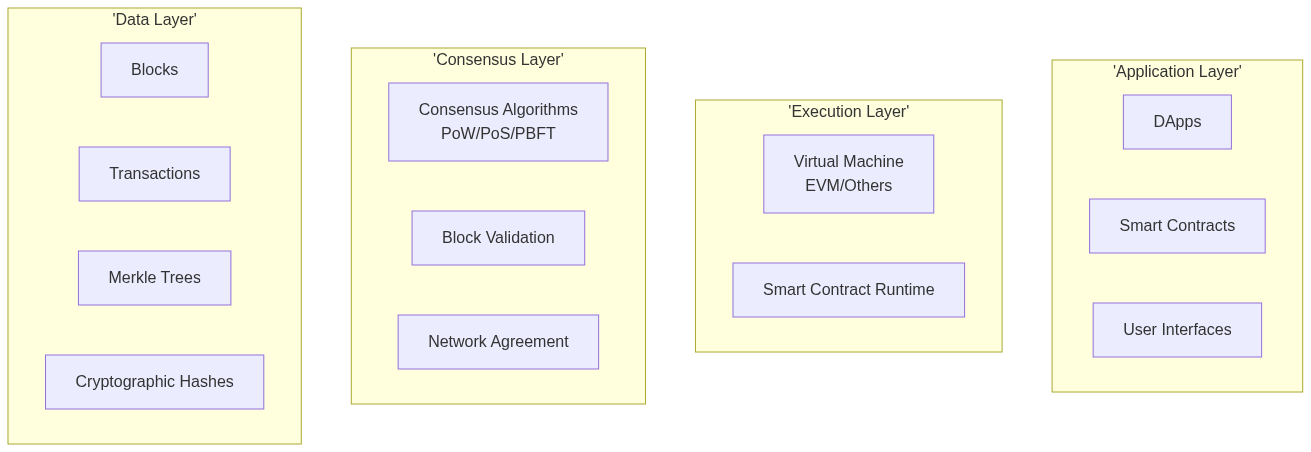
Detailed Component Architecture:
1. Network Layer (Foundation):
┌─────────────────────────────────────────────────────────┐
│              Peer-to-Peer Network Layer                 │
│  ┌──────┐    ┌──────┐    ┌──────┐    ┌──────┐         │
│  │Node 1│◄──►│Node 2│◄──►│Node 3│◄──►│Node 4│         │
│  └──────┘    └──────┘    └──────┘    └──────┘         │
│      ▲          ▲            ▲           ▲             │
│      │          │            │           │             │
│      └──────────┴────────────┴───────────┘             │
│           Gossip Protocol / Broadcasting               │
└─────────────────────────────────────────────────────────┘
Components:
- Nodes: Individual computers running blockchain software
- P2P Protocol: Direct communication between peers
- Node Discovery: Finding and connecting to other nodes
- Propagation: Broadcasting transactions and blocks
2. Data Layer (Core Structure):
┌─────────────────────────────────────────────────────────┐
│                    Data Structure                       │
│                                                         │
│  ┌─────────────────────────────────────────┐           │
│  │          Block Structure                 │           │
│  │  ┌────────────────────────────────────┐ │           │
│  │  │      Block Header                  │ │           │
│  │  │  ─────────────────────────────────│ │           │
│  │  │  - Version                         │ │           │
│  │  │  - Previous Block Hash ────────────┼─┼─► Links  │
│  │  │  - Merkle Root                     │ │   chain   │
│  │  │  - Timestamp                       │ │           │
│  │  │  - Difficulty Target               │ │           │
│  │  │  - Nonce                           │ │           │
│  │  └────────────────────────────────────┘ │           │
│  │  ┌────────────────────────────────────┐ │           │
│  │  │      Block Body                    │ │           │
│  │  │  ─────────────────────────────────│ │           │
│  │  │  - Transaction Counter             │ │           │
│  │  │  - Transaction List                │ │           │
│  │  │    • Tx1 (sender, receiver, amt)   │ │           │
│  │  │    • Tx2                           │ │           │
│  │  │    • Tx3                           │ │           │
│  │  │  - Merkle Tree (hash structure)    │ │           │
│  │  └────────────────────────────────────┘ │           │
│  └─────────────────────────────────────────┘           │
│                                                         │
│  Cryptographic Components:                             │
│  • Hash Functions (SHA-256)                            │
│  • Digital Signatures (ECDSA)                          │
│  • Public/Private Key Pairs                            │
└─────────────────────────────────────────────────────────┘
Components:
- Blocks: Container for transactions and metadata
- Transactions: Transfer of value or data
- Hashes: Unique identifiers ensuring integrity
- Merkle Trees: Efficient transaction verification structure
- Digital Signatures: Authentication and authorization
3. Consensus Layer:
┌─────────────────────────────────────────────────────────┐
│              Consensus Mechanisms                       │
│                                                         │
│  ┌────────────┐  ┌────────────┐  ┌────────────┐       │
│  │    PoW     │  │    PoS     │  │    PBFT    │       │
│  │  (Mining)  │  │  (Staking) │  │  (Voting)  │       │
│  └────────────┘  └────────────┘  └────────────┘       │
│                                                         │
│  Functions:                                             │
│  • Block Validation                                     │
│  • Transaction Ordering                                 │
│  • Network Agreement                                    │
│  • Fork Resolution                                      │
│  • Incentive Distribution                               │
└─────────────────────────────────────────────────────────┘
Components:
- Consensus Algorithms: Rules for achieving agreement
- Validators/Miners: Entities proposing new blocks
- Voting Mechanisms: How nodes agree on validity
- Reward Systems: Economic incentives
4. Execution Layer (Smart Contracts):
┌─────────────────────────────────────────────────────────┐
│          Execution Environment                          │
│                                                         │
│  ┌─────────────────────────────────────────┐           │
│  │   Virtual Machine (e.g., EVM)           │           │
│  │  ─────────────────────────────────────  │           │
│  │  • Bytecode Execution                   │           │
│  │  • Gas Metering                         │           │
│  │  • State Management                     │           │
│  │  • Isolation & Sandboxing               │           │
│  └─────────────────────────────────────────┘           │
│                                                         │
│  Smart Contract State Storage                          │
│  ┌──────────────────────────────────┐                  │
│  │  Contract 1: State Variables     │                  │
│  │  Contract 2: State Variables     │                  │
│  │  Contract 3: State Variables     │                  │
│  └──────────────────────────────────┘                  │
└─────────────────────────────────────────────────────────┘
Components:
- Virtual Machine: Executes smart contract code
- Gas System: Measures computational resources
- State Storage: Persistent contract data
- Runtime Environment: Isolated execution sandbox
5. Application Layer:
┌─────────────────────────────────────────────────────────┐
│          Application Layer                              │
│                                                         │
│  ┌──────────┐  ┌──────────┐  ┌──────────┐             │
│  │  Wallets │  │  DApps   │  │   APIs   │             │
│  └──────────┘  └──────────┘  └──────────┘             │
│  ┌──────────┐  ┌──────────┐  ┌──────────┐             │
│  │Explorers │  │ Exchanges│  │ Services │             │
│  └──────────┘  └──────────┘  └──────────┘             │
│                                                         │
│  User Interfaces and Services                          │
└─────────────────────────────────────────────────────────┘
Components:
- DApps: Decentralized applications
- Wallets: User interfaces for managing keys and transactions
- Explorers: Blockchain data visualization tools
- APIs: Programmatic access to blockchain data
Complete System Architecture:
        Users/Applications
               │
               ▼
    ┌─────────────────────┐
    │  Application Layer  │ ─► DApps, Wallets, UIs
    └──────────┬──────────┘
               │
    ┌──────────▼──────────┐
    │  Execution Layer    │ ─► Smart Contracts, EVM
    └──────────┬──────────┘
               │
    ┌──────────▼──────────┐
    │  Consensus Layer    │ ─► PoW, PoS, PBFT
    └──────────┬──────────┘
               │
    ┌──────────▼──────────┐
    │    Data Layer       │ ─► Blocks, Transactions
    └──────────┬──────────┘
               │
    ┌──────────▼──────────┐
    │   Network Layer     │ ─► P2P Communication
    └─────────────────────┘
Key Architectural Principles:
1. Decentralization:
- No central authority or server
- Distributed across multiple nodes
- Peer-to-peer communication
2. Transparency:
- All transactions publicly visible
- Anyone can verify blockchain state
- Open-source protocols
3. Immutability:
- Historical data cannot be changed
- Cryptographic linking prevents tampering
- Consensus required for updates
4. Security:
- Cryptographic hashing
- Digital signatures
- Consensus mechanisms
- Distributed validation
5. Autonomy:
- Self-governing network
- Automatic execution (smart contracts)
- Rule-based operations
Node Architecture:
┌────────────────────────────────────────────┐
│           Full Node Components             │
│                                            │
│  ┌──────────────────────────────────────┐ │
│  │  Blockchain Data Storage             │ │
│  │  (Complete copy of blockchain)       │ │
│  └──────────────────────────────────────┘ │
│  ┌──────────────────────────────────────┐ │
│  │  Transaction Pool (Mempool)          │ │
│  └──────────────────────────────────────┘ │
│  ┌──────────────────────────────────────┐ │
│  │  Validation Engine                   │ │
│  │  • Transaction verification          │ │
│  │  • Block verification                │ │
│  └──────────────────────────────────────┘ │
│  ┌──────────────────────────────────────┐ │
│  │  Consensus Module                    │ │
│  │  • Mining/Validation logic           │ │
│  └──────────────────────────────────────┘ │
│  ┌──────────────────────────────────────┐ │
│  │  Network Communication               │ │
│  │  • P2P protocol handler              │ │
│  │  • Block/Transaction broadcasting    │ │
│  └──────────────────────────────────────┘ │
│  ┌──────────────────────────────────────┐ │
│  │  Wallet / Key Management             │ │
│  └──────────────────────────────────────┘ │
│  ┌──────────────────────────────────────┐ │
│  │  RPC/API Interface                   │ │
│  └──────────────────────────────────────┘ │
└────────────────────────────────────────────┘
Summary:
Blockchain architecture is a multi-layered system combining cryptography, distributed systems, consensus mechanisms, and application logic to create a secure, transparent, and decentralized platform for digital transactions and smart contracts.
Question 14
(a) Enumerate benefits and limitations of using blockchain technology (7 marks)
Benefits of Blockchain Technology:
1. Decentralization:
- Benefit: No single point of control or failure
- Impact: Eliminates dependence on central authorities (banks, governments, corporations)
- Example: Bitcoin operates without any central bank or administrator
- Advantage: Reduces censorship, increases resilience, distributes power
2. Transparency and Auditability:
- Benefit: All transactions are visible to network participants
- Impact: Complete audit trail from genesis block to present
- Example: Anyone can trace Bitcoin transactions through block explorers
- Advantage: Reduces fraud, increases accountability, builds trust
3. Immutability:
- Benefit: Once recorded, data cannot be altered or deleted
- Impact: Historical records are tamper-proof and permanent
- Example: Medical records stored on blockchain cannot be retroactively changed
- Advantage: Data integrity, trust in records, legal evidence
4. Enhanced Security:
- Benefit: Cryptographic protection and distributed validation
- Impact: Resistant to hacking, fraud, and unauthorized access
- Example: Requires controlling 51% of network to compromise Bitcoin
- Advantage: Protection against data breaches, cyber attacks, and tampering
5. Reduced Costs:
- Benefit: Eliminates intermediaries and manual processes
- Impact: Lower transaction fees and operational costs
- Example: International remittances without bank fees
- Advantage: Direct peer-to-peer transactions, automated processes
6. Faster Transactions:
- Benefit: 24/7 operation without banking hours or delays
- Impact: Near real-time settlement compared to traditional systems
- Example: Cross-border payments in minutes vs. days
- Advantage: Improved efficiency, better cash flow, instant settlements
7. Traceability:
- Benefit: Complete transaction history and provenance tracking
- Impact: Can track items from origin to destination
- Example: Supply chain tracking of food products from farm to table
- Advantage: Authenticity verification, counterfeit prevention, quality control
8. Smart Contract Automation:
- Benefit: Self-executing agreements without intermediaries
- Impact: Automatic enforcement of contractual terms
- Example: Insurance claims automatically paid when conditions met
- Advantage: Reduced disputes, faster execution, lower costs
9. Increased Accessibility:
- Benefit: Anyone with internet can participate
- Impact: Financial inclusion for unbanked populations
- Example: 1.7 billion unbanked people can access cryptocurrency
- Advantage: Democratic access, global participation, reduced barriers
10. Data Ownership:
- Benefit: Users control their own data and private keys
- Impact: No central entity owns or controls user information
- Example: Decentralized identity systems
- Advantage: Privacy protection, reduced data monopolies, user empowerment
Limitations of Blockchain Technology:
1. Scalability Issues:
- Problem: Limited transaction processing capacity
- Impact: Bitcoin processes ~7 tx/s vs. Visa's ~24,000 tx/s
- Consequence: Network congestion, high fees during peak times
- Example: Bitcoin network congestion in 2017 led to $50+ fees
- Challenge: Difficult to scale while maintaining decentralization
2. Energy Consumption:
- Problem: Proof of Work requires massive computational power
- Impact: Bitcoin mining consumes as much energy as entire countries
- Consequence: Environmental concerns, high operational costs
- Example: Bitcoin network consumes ~150 TWh/year (similar to Argentina)
- Challenge: Sustainability concerns conflict with security benefits
3. Slow Transaction Speed:
- Problem: Block creation time and confirmation delays
- Impact: Bitcoin: ~10 minutes per block, Ethereum: ~15 seconds
- Consequence: Not suitable for instant payment scenarios
- Example: Retail purchases require faster confirmation than blockchain provides
- Challenge: Trade-off between security (confirmations) and speed
4. Storage Requirements:
- Problem: Full nodes must store entire blockchain history
- Impact: Bitcoin blockchain exceeds 500GB and growing
- Consequence: High storage costs, limits full node participation
- Example: Small devices cannot run full nodes
- Challenge: Centralization risk as fewer entities can afford full nodes
5. Irreversibility:
- Problem: Transactions cannot be reversed once confirmed
- Impact: Mistakes, fraud, or errors are permanent
- Consequence: Lost funds cannot be recovered
- Example: Sending to wrong address means permanent loss
- Challenge: No consumer protection like credit card chargebacks
6. Regulatory Uncertainty:
- Problem: Unclear legal status in many jurisdictions
- Impact: Compliance challenges, potential legal risks
- Consequence: Business hesitation, adoption barriers
- Example: Cryptocurrency regulations vary widely by country
- Challenge: Balancing innovation with regulatory compliance
7. Complexity:
- Problem: Technical complexity creates barriers to entry
- Impact: Steep learning curve for users and developers
- Consequence: Limited mainstream adoption
- Example: Managing private keys, understanding wallets, gas fees
- Challenge: Need for better user experiences and education
8. Lack of Privacy (Public Blockchains):
- Problem: All transactions are publicly visible
- Impact: Pseudonymous but not anonymous
- Consequence: Transaction history can be analyzed and traced
- Example: Bitcoin addresses can be linked to real identities
- Challenge: Balancing transparency with privacy needs
9. 51% Attack Vulnerability:
- Problem: Entity controlling majority hash rate can compromise network
- Impact: Can reverse transactions, double-spend
- Consequence: Network security depends on decentralization
- Example: Smaller blockchains have been successfully attacked
- Challenge: Maintaining sufficient decentralization and hash power
10. Interoperability Issues:
- Problem: Different blockchains cannot easily communicate
- Impact: Fragmented ecosystem, isolated networks
- Consequence: Limited cross-chain functionality
- Example: Bitcoin and Ethereum operate independently
- Challenge: Need for cross-chain bridges and standards
11. Initial Cost and Implementation:
- Problem: High upfront costs for infrastructure and development
- Impact: Significant investment required for deployment
- Consequence: Barrier for small businesses and startups
- Example: Enterprise blockchain implementation costs millions
- Challenge: ROI justification, resource allocation
12. Legal and Compliance Issues:
- Problem: Immutability conflicts with data protection regulations
- Impact: GDPR "right to be forgotten" vs. blockchain permanence
- Consequence: Legal conflicts, compliance challenges
- Example: Cannot delete personal data from blockchain per GDPR requirements
- Challenge: Adapting blockchain to regulatory requirements
Comparison Table:
| Aspect | Benefits | Limitations |
|---|---|---|
| Control | Decentralized, democratic | Complex governance, hard to upgrade |
| Security | Cryptographically secure, tamper-proof | 51% attack risk, irreversible errors |
| Speed | 24/7 operation | Slow confirmation times |
| Cost | No intermediary fees | High energy costs (PoW), development costs |
| Transparency | Full auditability | Privacy concerns |
| Access | Global, inclusive | Technical barriers, digital divide |
| Scalability | Distributed network | Limited throughput |
Conclusion:
While blockchain offers revolutionary benefits in decentralization, security, and transparency, it faces significant challenges in scalability, energy consumption, and regulatory compliance. The technology is best suited for applications where these benefits outweigh the limitations.
(b) How is decentralisation achieved in blockchain technology? (7 marks)
Decentralization in Blockchain:
Decentralization refers to the distribution of control, power, and authority away from a central point to multiple independent participants in the network. In blockchain, this is achieved through various architectural and protocol design choices.
Mechanisms for Achieving Decentralization:
1. Distributed Network Architecture:
Implementation:
- Peer-to-peer (P2P) network topology where all nodes are equal
- No central server or master node controlling the network
- Each node maintains an independent copy of the blockchain
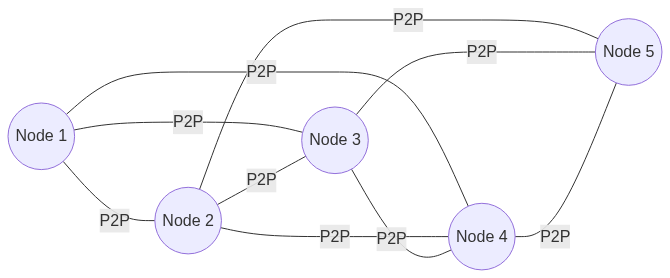
How it Achieves Decentralization:
- Every node can communicate directly with any other node
- No single point of failure or control
- Network continues functioning even if some nodes fail
- Example: Bitcoin has ~15,000+ full nodes globally
2. Distributed Consensus Mechanisms:
Implementation:
Network participants collectively agree on the blockchain state without central coordinator
Types:
- Proof of Work (PoW): Miners compete through computational work
- Proof of Stake (PoS): Validators selected based on stake
- Practical Byzantine Fault Tolerance (PBFT): Voting-based consensus
- Delegated Proof of Stake (DPoS): Stakeholders elect validators
How it Achieves Decentralization:
- No single entity decides which transactions are valid
- Multiple independent validators must agree
- Consensus rules are transparent and automatic
- Example: Bitcoin mining power distributed globally across thousands of miners
3. Distributed Ledger Replication:
Implementation:
Node 1:  [Genesis]→[Block 1]→[Block 2]→[Block 3]→...
Node 2:  [Genesis]→[Block 1]→[Block 2]→[Block 3]→...
Node 3:  [Genesis]→[Block 1]→[Block 2]→[Block 3]→...
   ⋮              (Identical copies)               ⋮
How it Achieves Decentralization:
- Every full node maintains complete blockchain copy
- No single "master" database
- Data integrity verified independently by each node
- Loss of individual nodes doesn't affect data availability
4. Cryptographic Key Management:
Implementation:
- Users control private keys independently
- No central authority manages or recovers keys
- Transactions authorized only by private key holder
Structure:
User → Private Key (secret) → Signs Transactions
       Public Key (shared) → Receives Payments
       Address (derived) → Public identifier
How it Achieves Decentralization:
- Users have direct control over their assets
- No intermediary can freeze or control funds
- Self-sovereignty over digital assets
- Example: "Not your keys, not your coins"
5. Decentralized Transaction Validation:
Process:
Transaction Created
    ↓
Broadcast to Network
    ↓
Multiple Nodes Validate Independently:
  • Node 1: Checks signature, balance, format ✓
  • Node 2: Checks signature, balance, format ✓
  • Node 3: Checks signature, balance, format ✓
  • Node N: Checks signature, balance, format ✓
    ↓
Consensus on Validity
    ↓
Included in Block
How it Achieves Decentralization:
- No central clearing house
- Distributed validation by independent nodes
- Consensus-based acceptance
- Byzantine fault tolerance (system works even if some nodes are malicious)
6. Open Source Protocol:
Implementation:
- Blockchain code is publicly available
- Anyone can review, audit, or fork the code
- Transparent rules and algorithms
How it Achieves Decentralization:
- No proprietary control over protocol
- Community-driven development
- Anyone can participate or create alternatives
- Example: Bitcoin Core, Ethereum clients have multiple implementations
7. Permissionless Participation:
Implementation:
- Anyone can join network without approval
- No gatekeepers or membership requirements
- Open access to read, write, and validate
Participation Levels:
User Level:
• Create wallet
• Send/receive transactions
• No permission needed

Node Operator Level:
• Download blockchain software
• Sync with network
• Validate transactions
• No approval required

Miner/Validator Level:
• Run mining software
• Propose blocks
• Earn rewards
• Economic participation open to all
How it Achieves Decentralization:
- Barrier to entry is technical, not institutional
- No central authority grants access
- Global, inclusive participation
8. Economic Incentive Distribution:
Implementation:
- Block rewards distributed to miners/validators
- Transaction fees paid to block producers
- Economic participation opportunities for all
Mechanism:
Block Reward → Distributed to:
  • Miners (PoW networks)
  • Validators (PoS networks)
  • Masternodes (some networks)

Transaction Fees → Paid to:
  • Block producer
  • Distributed based on contribution
How it Achieves Decentralization:
- Economic power distributed among many participants
- Incentives align with network security
- No central entity receives all fees
- Example: Bitcoin block rewards distributed to whoever mines the block
9. Governance Decentralization:
Implementation:
- Protocol changes require broad consensus
- Community voting on proposals
- Hard forks allow dissenting groups to split
Models:
- Off-chain governance: Discussion and BIP proposals (Bitcoin)
- On-chain governance: Token-based voting (Tezos, Polkadot)
- Rough consensus: Developer and community agreement
How it Achieves Decentralization:
- No single entity can unilaterally change protocol
- Community participation in decision-making
- Ability to fork provides ultimate check on power
10. Data Distribution and Availability:
Implementation:
Data Redundancy across Network:
┌─────────┐
│ Block 1 │ → Stored on: Node 1, 2, 3, ..., N
├─────────┤
│ Block 2 │ → Stored on: Node 1, 2, 3, ..., N
├─────────┤
│ Block 3 │ → Stored on: Node 1, 2, 3, ..., N
└─────────┘
How it Achieves Decentralization:
- No single repository of data
- High availability (multiple copies)
- Resistant to censorship (data can't be taken offline)
- Example: Thousands of nodes store complete Bitcoin blockchain
Levels of Decentralization:
| Aspect | Centralized | Federated | Decentralized |
|---|---|---|---|
| Control | Single entity | Consortium | Distributed |
| Access | Permissioned | Restricted | Permissionless |
| Trust | Trust authority | Trust members | Trust protocol |
| Examples | Traditional banks | Ripple | Bitcoin, Ethereum |
Challenges to Decentralization:
- Mining/Staking Pools: Concentration of hash power/stake
- Wealth Concentration: Large stakeholders have more influence
- Developer Centralization: Small core development teams
- Infrastructure: Cloud providers hosting many nodes
- Economic Barriers: High costs to run full nodes
Degree of Decentralization:
                  Increasing Decentralization →
    ┌──────┬──────────┬────────────┬───────────────┐
    │Single│ Federated│ Distributed│   Fully       │
    │Point │  Nodes   │   Nodes    │ Decentralized │
    └──────┴──────────┴────────────┴───────────────┘
  Examples:
  Traditional  Ripple    Ethereum   Bitcoin (ideal)
    Banking
Conclusion:
Decentralization in blockchain is achieved through a combination of distributed network architecture, consensus mechanisms, cryptographic security, economic incentives, and governance models. These elements work together to eliminate single points of control, distribute power among participants, and create a trustless system where the protocol, not intermediaries, enforces rules and maintains integrity.
The degree of decentralization varies across different blockchain implementations, with public permissionless blockchains like Bitcoin representing the highest level, and private/consortium blockchains offering reduced decentralization in exchange for performance or privacy benefits.
Module III - Consensus Algorithms and Bitcoin — #### Question 15
Question 15
(a) Explain the need for consensus algorithms in blockchain technology (7 marks)
Consensus Algorithms in Blockchain:
Consensus is the process by which a distributed network of nodes agrees on a single version of truth - the current state of the blockchain - without relying on a central authority. Consensus algorithms are fundamental to blockchain's decentralized operation.
Need for Consensus Algorithms:
1. Achieving Agreement in Distributed Systems:
Problem: In a decentralized network with thousands of independent nodes, how do all participants agree on which transactions are valid and in what order they should be recorded?
Solution: Consensus algorithms provide a systematic way for nodes to reach agreement on the blockchain state despite:
- Geographic distribution
- Network latency
- Potential node failures
- Malicious actors
Example: When two miners find valid blocks simultaneously, consensus rules determine which block the network accepts, preventing chain splits.
2. Preventing Double-Spending:
Problem: In digital systems, data can be copied infinitely. Without consensus, a user could spend the same cryptocurrency multiple times by broadcasting conflicting transactions to different parts of the network.
Solution: Consensus ensures all nodes agree on transaction order and validity, making double-spending detectable and preventable.
Scenario:
Alice has 1 BTC
Transaction A: Alice sends 1 BTC to Bob
Transaction B: Alice sends same 1 BTC to Charlie
Both broadcast simultaneously

Consensus algorithm ensures:
→ Only one transaction is accepted network-wide
→ The other is rejected as invalid (double-spend attempt)
3. Maintaining Network Security:
Need: Protect the blockchain from malicious actors attempting to:
- Alter historical transactions
- Insert fraudulent transactions
- Disrupt network operation
- Censor specific transactions
How Consensus Helps:
- Byzantine Fault Tolerance: System continues functioning correctly even when some nodes are faulty or malicious
- Economic Disincentives: Attacking the network costs more than honest participation (PoW, PoS)
- Cryptographic Proof: Consensus mechanisms require computational or economic proof that's expensive to fake
4. Establishing Trust Without Trusted Third Party:
Traditional System: Banks, payment processors act as trusted intermediaries to validate transactions.
Blockchain Challenge: How to establish trust in a system where participants don't know or trust each other?
Consensus Solution:
- Trust is placed in mathematics and cryptography, not institutions
- Transparent, verifiable rules that all participants follow
- No single entity can manipulate the ledger
- "Don't trust, verify" - anyone can independently validate the entire history
5. Ensuring Data Consistency:
Problem: With thousands of nodes maintaining separate copies of the blockchain, how do we ensure all copies remain identical?
Solution: Consensus algorithms guarantee that:
- All nodes eventually converge on the same state
- New blocks are added in the same order on all nodes
- Invalid blocks are rejected by all nodes
- Network maintains a single, consistent history
6. Ordering Transactions:
Challenge: Transactions arrive at different nodes at different times due to network propagation delays.
Consensus Role:
- Establishes canonical order for all transactions
- Prevents conflicts from out-of-order processing
- Ensures deterministic state transitions
- Creates an immutable timeline of events
Example:
Node 1 receives: Tx A → Tx B → Tx C
Node 2 receives: Tx B → Tx A → Tx C

Consensus ensures all nodes agree on final order:
Final blockchain: Tx A → Tx B → Tx C
7. Enabling Decentralization:
Requirement: For blockchain to be truly decentralized, no single entity should control which transactions are included or how the chain evolves.
Consensus Achievement:
- Distributes decision-making power among many participants
- Creates level playing field (in permissionless blockchains)
- Prevents centralization of control
- Makes censorship extremely difficult
8. Handling Network Partitions and Forks:
Issue: Network splits (partitions) can occur due to:
- Technical failures
- Protocol upgrades
- Simultaneous block discoveries
Consensus Response:
- Provides clear fork resolution rules
- Ensures network eventually converges on single chain
- Defines "longest chain" or "heaviest chain" selection
- Minimizes disruption from temporary splits
9. Incentivizing Participation:
Challenge: Why would anyone spend resources (computing power, stake, bandwidth) to maintain the network?
Consensus Solution:
- Rewards block creators with newly minted cryptocurrency
- Distributes transaction fees to validators
- Creates economic game theory that encourages honest behavior
- Makes attacks economically irrational
10. Adapting to Different Requirements:
Reality: Different blockchain use cases have different needs:
- Public blockchains: Maximize decentralization and censorship resistance
- Private blockchains: Optimize for speed and known participants
- Hybrid systems: Balance between extremes
Consensus Flexibility:
Different algorithms suit different needs:
- PoW: Maximum decentralization, high security, energy-intensive
- PoS: Energy-efficient, requires token ownership
- PBFT: Fast finality, works well with known validators
- DPoS: Democratic delegation, higher throughput
Types of Consensus Mechanisms:
| Consensus Type | Use Case | Key Feature |
|---|---|---|
| Proof of Work | Bitcoin, Ethereum (legacy) | Computational puzzle |
| Proof of Stake | Ethereum 2.0, Cardano | Economic stake |
| PBFT | Hyperledger Fabric | Voting-based, permissioned |
| Raft/Paxos | Internal distributed systems | Crash fault tolerance |
| DPoS | EOS, Tron | Delegated validators |
Consensus Challenges:
- Trilemma: Balancing decentralization, security, and scalability
- Energy Efficiency: PoW requires massive energy consumption
- Finality: How quickly transactions become irreversible
- Participation: Encouraging broad, distributed participation
- Upgrades: Evolving consensus rules without fragmenting network
Conclusion:
Consensus algorithms are the beating heart of blockchain technology. They solve the fundamental challenge of achieving agreement in a distributed, trustless environment. Without consensus:
- Blockchain would require central authorities (defeating the purpose)
- Double-spending would be trivial
- Network would fragment into incompatible versions
- Security would be compromised
- Decentralization would be impossible
Consensus algorithms transform a network of self-interested, potentially adversarial participants into a cohesive system that maintains a single, secure, immutable ledger - the core innovation of blockchain technology.
(b) What are crash fault tolerant algorithms? Compare PoW and PoS (7 marks)
Crash Fault Tolerant (CFT) Algorithms:
Definition:
Crash Fault Tolerant algorithms are consensus mechanisms designed to handle crash failures - situations where nodes stop functioning (crash) but do not behave maliciously. These algorithms assume nodes are honest but may fail unexpectedly.
Characteristics of CFT Algorithms:
-
Failure Model: Assumes nodes either:
- Function correctly (follow protocol)
- Crash and stop responding (fail-stop model)
- Do NOT behave maliciously or send conflicting messages
-
Use Cases: Primarily used in:
- Permissioned/private blockchains
- Internal distributed systems
- Enterprise environments with known participants
- Systems where Byzantine failures are unlikely
Common CFT Algorithms:
1. Paxos:
- Developed by Leslie Lamport
- Achieves consensus through proposal and acceptance phases
- Leader-based approach with multiple rounds
- Tolerates up to (N-1)/2 node failures
- Complex but theoretically sound
2. Raft:
- Designed as more understandable alternative to Paxos
- Leader election, log replication, and safety mechanisms
- Easier to implement and understand
- Used in systems like etcd, Consul
- Tolerates (N-1)/2 failures
Working Principle:
1. Leader Election: Nodes elect a leader
2. Log Replication: Leader replicates entries to followers
3. Commitment: Once majority acknowledges, entry is committed
4. If leader crashes: New leader elected, process continues
Limitations:
- Cannot handle malicious nodes (Byzantine failures)
- Unsuitable for public, permissionless blockchains
- Requires majority of nodes to be honest and functional
Comparison: Proof of Work (PoW) vs Proof of Stake (PoS)
Proof of Work (PoW):
Mechanism:
- Miners compete to solve computationally intensive cryptographic puzzles
- First to find solution gets to add block and receive rewards
- Difficulty adjusts to maintain consistent block time
How it Works:
1. Collect transactions from mempool
2. Create block with transactions + previous block hash
3. Find nonce such that: Hash(block + nonce) < Target
4. Broadcast valid block to network
5. Receive block reward + transaction fees
Key Features:
- Security: Attacking requires controlling 51% of hash power
- Decentralization: Anyone with hardware can participate
- Proven: Bitcoin has operated securely since 2009
Proof of Stake (PoS):
Mechanism:
- Validators "stake" cryptocurrency as collateral
- Validators selected to create blocks based on stake size and other factors
- Malicious behavior results in stake being "slashed" (confiscated)
How it Works:
1. Lock cryptocurrency as stake
2. Selection algorithm chooses validator (based on stake, age, randomization)
3. Selected validator proposes new block
4. Other validators attest to block validity
5. Rewards distributed to validators
6. Malicious behavior → stake slashed
Key Features:
- Energy Efficient: No computational puzzle solving
- Economic Security: Attacking requires owning significant stake
- Lower Barriers: No expensive mining hardware needed
Detailed Comparison Table:
| Aspect | Proof of Work (PoW) | Proof of Stake (PoS) |
|---|---|---|
| Resource Requirement | Computational power (hash rate) | Cryptocurrency stake (capital) |
| Energy Consumption | Extremely high (~150 TWh/year for Bitcoin) | Very low (~99.95% less than PoW) |
| Hardware Needed | Specialized mining equipment (ASICs) | Standard computer/server |
| Entry Barrier | High (expensive hardware, electricity costs) | Moderate (need to purchase/hold cryptocurrency) |
| 51% Attack Cost | Must control majority of hash power | Must own majority of staked tokens |
| Environmental Impact | Significant (carbon footprint) | Minimal |
| Block Validators | Miners (anyone with hardware) | Validators (token holders) |
| Reward Mechanism | Block reward + transaction fees | Transaction fees + inflation (varies) |
| Finality | Probabilistic (more confirmations = higher certainty) | Can achieve absolute finality (depends on implementation) |
| Centralization Risk | Mining pools concentrate power | Wealth concentration (rich get richer) |
| Security Model | Economic cost of attack > potential gain | Stake at risk (slashing) makes attacks costly |
| Scalability | Limited (block size, block time constraints) | Potentially higher (less computational overhead) |
| Fork Handling | Longest chain rule | Various rules (LMD GHOST in Ethereum 2.0) |
| Sunk Cost | Hardware depreciates, electricity consumed | Stake can be unstaked and sold |
| Examples | Bitcoin, Ethereum (pre-Merge), Litecoin | Ethereum (post-Merge), Cardano, Polkadot |
| Validator Selection | Random (first to solve puzzle) | Deterministic/pseudo-random based on stake |
| Nothing at Stake Problem | N/A | Potential issue (validators can vote on multiple forks) |
| Long-Range Attacks | Protected by cumulative PoW | Vulnerable (mitigated by checkpointing) |
| Time to Participation | Immediate (start mining anytime) | Stake locking period may apply |
| Decentralization Level | High (geographic distribution of miners) | Moderate (concentrated in large holders) |
Security Comparison:
PoW Attack Scenarios:
- 51% Attack: Attacker needs majority hash power
- Cost: Requires massive hardware investment + ongoing electricity
- Detection: Obvious (huge spike in hash rate)
- Recovery: Can fork to exclude attacker
PoS Attack Scenarios:
- 51% Attack: Attacker needs majority of staked coins
- Cost: Must purchase majority of circulating supply (price increases with buying)
- Deterrent: Stake gets slashed if malicious behavior detected
- Recovery: Attacker loses their stake
Economic Analysis:
PoW:
Attack Cost = (Hash Rate Needed × Equipment Cost) + (Electricity × Time)
Externalized: Can sell equipment after attack
Ongoing Cost: Electricity is continuous expense
PoS:
Attack Cost = Market Price × 51% of Supply
Locked In: Stake remains in system
Risk: Price crashes if attack known, attacker loses value
Advantages and Disadvantages:
PoW Advantages:
- Battle-tested security (Bitcoin: 14+ years)
- True permissionless participation
- External energy cost makes attacks expensive
- No "rich get richer" within protocol
PoW Disadvantages:
- Massive energy waste
- Centralization through mining pools
- High barrier to entry (expensive equipment)
- Environmental concerns
- Limited scalability
PoS Advantages:
- Energy efficient (~99.95% reduction)
- Lower hardware requirements
- Faster finality possible
- No mining pool centralization
- Better scalability potential
PoS Disadvantages:
- Wealth concentration (those with more stake earn more)
- "Nothing at Stake" theoretical vulnerability
- Less battle-tested than PoW
- Initial distribution challenge
- Potential for cartels among large holders
Hybrid Approaches:
Some blockchains combine elements:
- Ethereum's Path: Transitioned from PoW to PoS ("The Merge" - September 2022)
- Decred: Hybrid PoW/PoS system
- Casper: Gradual transition mechanism
Conclusion:
Crash Fault Tolerant algorithms (like Paxos, Raft) work well in permissioned environments but cannot handle malicious actors, making them unsuitable for public blockchains.
PoW vs PoS represents a fundamental trade-off:
- PoW prioritizes proven security and decentralization at the cost of energy efficiency
- PoS prioritizes energy efficiency and scalability while introducing different security assumptions
Neither is universally "better" - the choice depends on priorities:
- Public, trustless network with maximum security: PoW (Bitcoin)
- Energy-efficient, scalable network: PoS (Ethereum 2.0, Cardano)
- Permissioned, known participants: CFT algorithms (Hyperledger)
Question 16
(a) How are transactions validated in a Bitcoin network? (7 marks)
Bitcoin Transaction Validation:
Transaction validation in Bitcoin is a multi-layered process performed by network nodes to ensure only legitimate transactions are included in the blockchain. Every node independently validates transactions before accepting or relaying them.
Transaction Validation Process:
1. Structural Validation:
Nodes first check basic transaction structure and format:
Checks Performed:
- Syntax: Transaction follows correct data structure format
- Size Limits: Transaction size within acceptable limits (< 100,000 bytes)
- Output Values: All output values are within valid range (0 < value < 21 million BTC)
- Non-Empty: Transaction has at least one input and one output
- Coinbase Maturity: If spending coinbase transaction, it has 100+ confirmations
Example Validation:
Transaction Format Check:
✓ Valid JSON/binary structure
✓ All required fields present
✓ Field types correct (integers, hashes, etc.)
✗ Malformed data → REJECT
2. Input Validation:
Each transaction input must reference a valid, unspent previous output (UTXO):
Checks:
- UTXO Exists: Input references an existing transaction output
- Not Already Spent: Output hasn't been used in another confirmed transaction (no double-spending)
- Valid Reference: Previous transaction hash and output index are correct
- Output Maturity: Referenced output is confirmed (in blockchain)
UTXO (Unspent Transaction Output) Model:
Alice's Wallet:
UTXO 1: 0.5 BTC (from Tx ABC)
UTXO 2: 0.3 BTC (from Tx DEF)
Total Balance: 0.8 BTC

To spend 0.6 BTC:
Input 1: Reference UTXO 1 (0.5 BTC)
Input 2: Reference UTXO 2 (0.3 BTC)
Total Input: 0.8 BTC

Output 1: 0.6 BTC to Bob
Output 2: 0.19 BTC back to Alice (change)
Fee: 0.01 BTC

After transaction:
Alice's new UTXOs:
UTXO 3: 0.19 BTC (change)
Old UTXOs (1, 2) now spent (no longer UTXO)
3. Signature Verification:
Critical Security Check: Verify that the transaction creator owns the funds being spent.
Process:
For each input:
1. Extract public key from input's scriptSig
2. Retrieve scriptPubKey from referenced output
3. Execute: scriptSig + scriptPubKey (Bitcoin Script)
4. Verify digital signature using ECDSA
5. Ensure signature signs current transaction (not reused)
Example:
Previous Output (UTXO being spent):
scriptPubKey: OP_DUP OP_HASH160 <Alice's PubKey Hash> OP_EQUALVERIFY OP_CHECKSIG

Current Transaction Input:
scriptSig: <Alice's Signature> <Alice's Public Key>

Validation:
1. Execute combined script
2. Check: HASH160(Alice's Public Key) == PubKey Hash in scriptPubKey ✓
3. Verify: Signature is valid for this transaction using Alice's Public Key ✓
4. Result: VALID → Alice owns the UTXO and authorized this spend
4. Double-Spending Prevention:
Critical Check: Ensure inputs haven't been spent in another transaction.
Validation Steps:
- Check blockchain: Input UTXO not spent in any confirmed block
- Check mempool: Input UTXO not spent in another pending transaction
- If conflict detected: Apply first-seen rule (first valid transaction accepted)
Double-Spend Example:
Alice has 1 BTC UTXO

Attempt 1:
Tx A: Alice → Bob (1 BTC) [broadcast first]
Tx B: Alice → Charlie (same 1 BTC) [broadcast later]

Validation Result:
✓ Tx A: Accepted (first-seen)
✗ Tx B: Rejected (double-spend attempt - UTXO already spent in Tx A)
5. Value/Balance Verification:
Conservation Check: Sum of inputs ≥ Sum of outputs
Validation:
Total Input Value = Sum(all input UTXO values)
Total Output Value = Sum(all outputs)
Transaction Fee = Total Input - Total Output

Checks:
✓ Total Input ≥ Total Output
✓ Transaction Fee ≥ 0
✓ Transaction Fee is reasonable (not absurdly high)
✗ If Total Output > Total Input → REJECT (creating money from nothing)
Example:
Inputs:
- UTXO 1: 0.5 BTC
- UTXO 2: 0.3 BTC
Total Input: 0.8 BTC

Outputs:
- To Bob: 0.6 BTC
- Change to Alice: 0.19 BTC
Total Output: 0.79 BTC

Fee: 0.8 - 0.79 = 0.01 BTC ✓ VALID
6. Script Execution Validation:
Bitcoin Script: Stack-based scripting language for transaction conditions.
Validation Process:
1. Combine scriptSig (from input) and scriptPubKey (from referenced output)
2. Execute script operations sequentially
3. Valid if script completes with TRUE on top of stack
4. Check for:
   - No script errors
   - No illegal opcodes
   - Execution within size/operation limits
   - Final stack state is TRUE
Standard Transaction Scripts:
Pay-to-Public-Key-Hash (P2PKH) - Most Common:
scriptPubKey: OP_DUP OP_HASH160 <PubKeyHash> OP_EQUALVERIFY OP_CHECKSIG
scriptSig: <Signature> <PublicKey>

Execution:
Stack: [Signature] [PublicKey]
OP_DUP: [Signature] [PublicKey] [PublicKey]
OP_HASH160: [Signature] [PublicKey] [PubKeyHash']
<PubKeyHash>: [Signature] [PublicKey] [PubKeyHash'] [PubKeyHash]
OP_EQUALVERIFY: [Signature] [PublicKey] (if hashes match, continue)
OP_CHECKSIG: [TRUE or FALSE] (verify signature)
Result: TRUE → VALID
7. Additional Validation Rules:
Contextual Checks:
- Locktime: If locktime set, verify current block height/time exceeds it
- Sequence Numbers: Check for Replace-By-Fee (RBF) signals and relative timelocks
- SegWit Rules: For Segregated Witness transactions, validate witness data
- Standardness: Check if transaction follows "standard" patterns (for relay)
Consensus Rules:
- Block Subsidy: For coinbase transactions, reward matches current block height formula
- Sigops: Transaction doesn't exceed signature operation limits
- Version: Transaction version is recognized by this node
8. Mempool Acceptance:
After passing all validation:
Valid Transaction Path:
✓ All checks passed
→ Add to mempool (unconfirmed transaction pool)
→ Relay to peer nodes
→ Wait for miner to include in block

Invalid Transaction:
✗ Any check failed
→ Reject transaction
→ Do not relay
→ Optionally ban sender if malicious pattern detected
9. Block-Level Validation:
When transaction is included in a block, additional checks:
- All transactions in block are individually valid
- No duplicate transactions
- Coinbase transaction follows reward rules
- Block doesn't exceed size/weight limits
- Merkle root correctly represents all transactions
Validation Flowchart:
Transaction Received
    ↓
[Structural Validation]
    ↓ Valid
[Input Existence Check]
    ↓ Exists
[Signature Verification]
    ↓ Valid
[Double-Spend Check]
    ↓ Not Spent
[Value Conservation]
    ↓ Balanced
[Script Execution]
    ↓ TRUE
[Additional Rules]
    ↓ Pass
Add to Mempool & Relay
    ↓
[Wait for Mining]
    ↓
Included in Block
    ↓
[Block Validation]
    ↓
CONFIRMED
Who Validates:
- Full Nodes: Perform complete validation of every transaction and block
- Miners: Validate before including in blocks (economic incentive for correct validation)
- SPV Clients: Light validation using Merkle proofs (trust full nodes for detailed validation)
Validation Security:
Byzantine Fault Tolerance:
- Even if some nodes are malicious, honest majority ensures correct validation
- Each node validates independently (no trust required)
- Consensus on validity emerges from decentralized validation
Economic Incentives:
- Miners lose block rewards if they include invalid transactions
- Nodes that relay invalid transactions get banned
- Validation costs are low compared to security benefits
Conclusion:
Bitcoin transaction validation is a comprehensive, multi-layered process ensuring:
- Only legitimate transactions are processed
- No double-spending occurs
- Cryptographic ownership is verified
- Network consensus is maintained
- System remains secure and trustless
This decentralized validation process is fundamental to Bitcoin's security and eliminates the need for trusted third parties.
(b) Explain the different steps involved in mining a Bitcoin. What is the role of a miner in a Bitcoin network? (7 marks)
Bitcoin Mining Process:
Mining is the process of creating new blocks by solving computationally intensive cryptographic puzzles, securing the network and validating transactions.
Steps in Bitcoin Mining:
Step 1: Transaction Collection
Process:
- Miner's node listens to network for broadcast transactions
- Collects unconfirmed transactions from mempool
- Prioritizes transactions based on fees (higher fee = higher priority)
- Selects transactions to include in next block candidate
Selection Criteria:
Priority Calculation:
- Transaction fee (satoshis/byte)
- Transaction size
- Available block space (max ~4MB weight)

Goal: Maximize fee revenue within block size limits
Example:
Mempool has 5000 pending transactions
Miner selects:
- Top 2000 transactions by fee rate
- Total fees: 0.5 BTC
- Block space: ~3.8 MB
Step 2: Block Construction
Create Block Header:
Block Header Structure (80 bytes):
┌─────────────────────────────────────┐
│ Version (4 bytes)                   │
│ Previous Block Hash (32 bytes)      │ ← Links to previous block
│ Merkle Root (32 bytes)              │ ← Hash of all transactions
│ Timestamp (4 bytes)                 │ ← Current time
│ Difficulty Target (4 bytes)         │ ← Mining difficulty
│ Nonce (4 bytes)                     │ ← Variable to find
└─────────────────────────────────────┘
Create Coinbase Transaction:
First transaction in block (special):
- Input: No previous UTXO (created from nothing)
- Output: Block reward + transaction fees
- Includes: Block height, extra nonce
- Goes to miner's address

Current Block Reward (2024): 6.25 BTC
(Halves every 210,000 blocks ≈ 4 years)
Calculate Merkle Root:
Transactions:  Tx1  Tx2  Tx3  Tx4
               ↓    ↓    ↓    ↓
Hash Level 1:  H1   H2   H3   H4
               ↓    ↓    ↓    ↓
Hash Level 2:   H12      H34
                 ↓        ↓
Merkle Root:      H1234
Step 3: Set Mining Target
Difficulty Target:
- Network adjusts difficulty every 2016 blocks (~2 weeks)
- Goal: Maintain 10-minute average block time
- Represented as compact format in block header
Target Calculation:
Valid Block Hash must be LESS than Target

Example Target (simplified):
0000000000000000001234567890abcdef...

Valid hash must start with ~19 zeros (current Bitcoin difficulty)

Probability of finding valid hash:
P = Target / 2^256
(Extremely small, requires trillions of attempts)
Step 4: Hash Computation (The Actual "Mining")
Process:
For nonce = 0 to 4,294,967,295 (2^32 - 1):
    1. Block_Header = Version + Prev_Hash + Merkle_Root + Timestamp + Difficulty + nonce
    2. Hash = SHA256(SHA256(Block_Header))
    3. If Hash < Target:
           ✓ VALID BLOCK FOUND!
           → Broadcast to network
           → Collect rewards
           → Break
    4. Else:
           → Increment nonce
           → Try again

If all nonces exhausted:
    → Modify extra nonce in coinbase transaction
    → Recalculate Merkle root
    → Start over with nonce = 0
    → Or update timestamp
Example Hashing:
Attempt 1,000,000:
nonce = 1000000
Hash = 00001234abcd... ✗ (too large, doesn't meet target)

Attempt 5,483,293,182:
nonce = 3829471
Hash = 00000000000000000000abc... ✓ (meets target!)
VALID BLOCK FOUND!
Mining Difficulty:
Current Bitcoin Hash Rate: ~400 EH/s (exahashes per second)
= 400,000,000,000,000,000,000 hashes per second (network-wide)

Average attempts to find block: Trillions
Time: ~10 minutes (probabilistic)
Step 5: Block Validation (Self-Check)
Before broadcasting, miner validates own block:
✓ Block hash meets difficulty target
✓ All transactions valid
✓ Merkle root correct
✓ Coinbase reward correct (6.25 BTC + fees)
✓ Block size within limits
✓ Timestamp reasonable
Step 6: Block Broadcasting
Propagation:
Miner Node
    ↓
Broadcast to connected peers
    ↓
Peers validate block
    ↓ (if valid)
Peers relay to their peers
    ↓
Propagates through entire network
    ↓
Most nodes receive within seconds
Step 7: Network Acceptance
Other Nodes:
- Receive and validate the new block
- If valid: Add to their blockchain
- If valid: Stop mining current block, start on next
- Update UTXO set
- Miner receives confirmation
Mining Race:
If two miners find valid blocks simultaneously:
→ Temporary fork
→ Network splits temporarily
→ Next block determines winner (longest chain)
→ Orphaned block discarded
→ Miner of orphaned block receives no reward
Step 8: Reward Collection
Miner Receives:
Block Reward (fixed): 6.25 BTC (as of 2024)
Transaction Fees: Variable (sum of all tx fees in block)
Total: 6.25 + fees BTC

Coinbase transaction output:
- Spendable after 100 confirmations
- Ensures no spend from orphaned blocks
Mining Flowchart:
flowchart TD
    A[Listen for Transactions] --> B[Collect High-Fee Transactions]
    B --> C[Create Coinbase Transaction]
    C --> D[Build Merkle Tree]
    D --> E[Construct Block Header]
    E --> F[Set nonce = 0]
    F --> G[Calculate Hash = SHA256SHA256Block Header]
    G --> H{Hash < Target?}
    H -->|No| I[Increment Nonce]
    I --> J{Nonce Exhausted?}
    J -->|No| G
    J -->|Yes| K[Update Timestamp/Extra Nonce]
    K --> F
    H -->|Yes| L[Valid Block Found!]
    L --> M[Validate Own Block]
    M --> N[Broadcast to Network]
    N --> O[Receive Rewards]
Role of Miners in Bitcoin Network:
1. Transaction Validation and Inclusion:
- Verify transaction validity before including in blocks
- Select transactions from mempool
- Ensure no double-spending
- Maintain integrity of the ledger
2. Blockchain Security:
- Computational proof makes chain immutable
- Rewriting history requires redoing all PoW (computationally infeasible)
- Distributed mining prevents centralized control
- Economic incentive aligns with network security
3. Consensus Enforcement:
- Follow consensus rules (block size, reward schedule, etc.)
- Reject invalid blocks from other miners
- Participate in fork resolution (longest chain)
- Maintain network agreement on blockchain state
4. New Bitcoin Creation:
- Controlled issuance through block rewards
- Follows predetermined schedule (halving every 4 years)
- Eventually: 21 million BTC total supply (year ~2140)
- Current: ~19.5 million BTC in circulation
5. Network Time-Stamping:
- Blocks create irreversible timeline
- Timestamp service for transactions
- Prove transaction occurred at specific time
- Essential for double-spend prevention
6. Decentralization Maintenance:
- Geographic distribution of hash power
- Anyone can participate (permissionless)
- Prevents single point of control
- Resistance to censorship
Economic Aspects:
Mining Economics:
Revenue:
+ Block Reward: 6.25 BTC
+ Transaction Fees: ~0.5 BTC (variable)
= Total: ~6.75 BTC per block

Costs:
- Hardware (ASICs): $5,000 - $15,000 per unit
- Electricity: $5,000 - $20,000 per month (depending on rate and scale)
- Cooling, facility, maintenance

Profitability depends on:
• Bitcoin price
• Network difficulty
• Electricity costs
• Hardware efficiency
Mining Pools:
Most miners join pools to reduce variance:
Solo Mining:
- 0.01% chance to find block
- High variance (might wait months)
- Full reward if successful

Pool Mining:
- Contribute hash power to pool
- Receive proportional share of rewards
- Steady, predictable income
- Pool takes ~1-2% fee
Conclusion:
Bitcoin mining is a sophisticated process that:
- Secures the network through computational work
- Validates and timestamps transactions
- Creates new bitcoins on a predetermined schedule
- Achieves decentralized consensus
- Makes the blockchain immutable and trustless
Miners are essential participants who:
- Invest resources to maintain network security
- Are economically incentivized to behave honestly
- Enable Bitcoin to function without central authority
- Create a probabilistic, game-theoretic security model
The mining process elegantly solves the double-spending problem in a decentralized system, making Bitcoin a revolutionary innovation in digital currency and distributed consensus.
Module IV - Smart Contracts and Use Cases — #### Question 17
Question 17
(a) Explain the impact of blockchain technology to artificial intelligence (7 marks)
Blockchain and Artificial Intelligence Integration:
The convergence of blockchain and AI creates synergistic benefits, where blockchain addresses AI's challenges in trust, transparency, and data management, while AI enhances blockchain's efficiency and capabilities.
Impact of Blockchain on Artificial Intelligence:
1. Data Integrity and Provenance:
Challenge in AI:
- Training data quality crucial for AI model accuracy
- Data tampering can compromise model reliability
- Difficult to trace data origin and transformations
Blockchain Solution:
- Immutable record of data collection and modifications
- Cryptographic verification of data authenticity
- Complete audit trail of data lineage
Example:
Medical AI Training Data:
Block 1: Patient Data Collected (Hospital A, Date, Hash)
Block 2: Data Anonymized (Process, Date, Hash)
Block 3: Data Validated (Validator, Date, Hash)
Block 4: Added to Training Set (Model Version, Date)

Result: Verifiable, untampered training data
Impact: Higher confidence in AI models, regulatory compliance, reduced bias from corrupted data.
2. Decentralized AI Model Training:
Traditional AI:
- Centralized training on single entity's infrastructure
- Data silos prevent collaborative learning
- Privacy concerns with data sharing
Blockchain-Enabled:
- Distributed training across multiple parties
- Federated learning with blockchain coordination
- Data remains with owners, only model updates shared
Architecture:
┌─────────────┐  ┌─────────────┐  ┌─────────────┐
│  Hospital A │  │  Hospital B │  │  Hospital C │
│  Local Data │  │  Local Data │  │  Local Data │
│  Local Train│  │  Local Train│  │  Local Train│
└──────┬──────┘  └──────┬──────┘  └──────┬──────┘
       │                 │                 │
       └────────┬────────┴────────┬────────┘
                │                 │
          Model Updates     Model Updates
                │                 │
        ┌───────▼─────────────────▼───────┐
        │  Blockchain - Aggregates Updates │
        │  Smart Contract Coordinates      │
        └──────────────┬───────────────────┘
                       │
                 Global Model
Impact: Better AI models through diverse data, privacy preservation, democratized AI development.
3. AI Model Marketplace and Monetization:
Problem:
- Difficult to monetize AI models
- Lack of trust in model authenticity
- IP protection challenges
Blockchain Solution:
- Smart contracts for automated licensing
- Tokenization of AI models as digital assets
- Transparent usage tracking and payment
Example Marketplace:
contract AIModelMarketplace {
    struct Model {
        address owner;
        string modelHash; // IPFS hash
        uint256 price;
        uint256 usageCount;
    }

    mapping(uint256 => Model) public models;

    function purchaseModelAccess(uint256 modelId) public payable {
        require(msg.value >= models[modelId].price);
        // Grant access, record on blockchain
        // Pay owner automatically
    }
}
Impact: New economic models for AI, incentivized innovation, fair compensation for model creators.
4. Transparent and Explainable AI:
AI Challenge:
- "Black box" decision-making
- Difficult to audit AI decisions
- Accountability concerns
Blockchain Enhancement:
- Record every AI decision on blockchain
- Immutable log of inputs, outputs, and model versions
- Traceable decision history
Decision Audit Trail:
Loan Application Decision:
├─ Block 100: Input Data (applicant info hash)
├─ Block 101: Model Used (version 2.3, hash)
├─ Block 102: Decision (Approved/Denied)
├─ Block 103: Confidence Score (87%)
└─ Block 104: Reasoning Factors (stored hash)

Any stakeholder can verify:
- Which model version made decision
- When decision was made
- Decision hasn't been altered
Impact: Regulatory compliance (GDPR, AI Act), increased trust, accountability for AI systems.
5. Decentralized AI Computing Resources:
Challenge:
- AI training requires massive computing power
- Expensive infrastructure
- Centralized control by big tech
Blockchain Solution:
- Decentralized computing marketplaces
- Token-based incentives for contributing resources
- Projects: Golem, iExec, SingularityNET
Model:
Resource Providers (GPU owners)
          ↓
   Contribute computing power
          ↓
Blockchain coordinates task distribution
          ↓
AI developers rent resources via smart contracts
          ↓
Automatic payment in cryptocurrency
Impact: Democratized access to AI infrastructure, reduced costs, efficient resource utilization.
6. Data Privacy with Secure Computation:
Privacy Challenge:
- AI needs data access for training
- Data owners want privacy
- Regulatory requirements (GDPR, HIPAA)
Blockchain Integration:
- Zero-knowledge proofs for private AI inference
- Homomorphic encryption on blockchain
- Secure multi-party computation coordinated by smart contracts
Example:
Healthcare AI Diagnosis:
1. Patient data encrypted (never leaves device)
2. Encrypted data sent to AI model
3. Computation on encrypted data (homomorphic)
4. Result decrypted only by patient
5. All interactions recorded on blockchain
6. No party sees raw patient data
Impact: Privacy-preserving AI, regulatory compliance, user empowerment.
7. AI-Generated Content Authentication:
Deepfake/Misinformation Problem:
- AI can create fake images, videos, text
- Difficult to distinguish real from synthetic
- Trust erosion in media
Blockchain Solution:
- Digital signatures for authentic content
- Timestamp and provenance tracking
- NFTs for original AI-generated art
Verification System:
Content Creation:
├─ Real photo taken → Signed with blockchain timestamp
├─ Hash stored on blockchain
└─ Later verification: Compare hash, check timestamp

AI-Generated Content:
├─ Clearly labeled as AI-generated
├─ Model and prompt recorded on blockchain
└─ Transparent about synthetic origin
Impact: Combat misinformation, content authenticity verification, creative rights protection.
8. Autonomous AI Agents with Smart Contracts:
Vision:
- AI agents that can autonomously transact
- Machine-to-machine economy
- Self-governing AI systems
Implementation:
AI Agent (bot) interacts with blockchain:
1. Receives cryptocurrency for services
2. Pays for data/compute resources
3. Executes smart contract functions
4. Manages own digital assets
5. All actions auditable on blockchain
Use Cases:
- Autonomous vehicles paying for charging
- AI assistants purchasing information
- Robotic process automation with payments
Impact: New economic paradigm, AI autonomy with accountability, machine economies.
Challenges in Blockchain-AI Integration:
| Challenge | Description | Potential Solution |
|---|---|---|
| Scalability | Blockchain throughput limits AI data volume | Layer 2 solutions, off-chain computation |
| Latency | Block confirmation time delays AI inference | Sidechains, state channels |
| Storage | Blockchain storage expensive for large AI models | IPFS, Filecoin integration |
| Privacy vs Transparency | Blockchain transparency conflicts with data privacy | Zero-knowledge proofs, encryption |
| Energy | Both technologies energy-intensive | Proof of Stake, efficient algorithms |
Real-World Examples:
- Ocean Protocol: Decentralized data marketplace for AI
- SingularityNET: Decentralized AI services marketplace
- Fetch.ai: Autonomous AI agents on blockchain
- Numerai: Crowdsourced hedge fund using blockchain and AI
- Cortex: AI models on blockchain
Future Impact:
Short Term (1-3 years):
- AI model marketplaces gain adoption
- Federated learning with blockchain coordination
- Content authenticity verification systems
Medium Term (3-7 years):
- Decentralized AI training becomes mainstream
- Regulatory frameworks for blockchain-AI
- Widespread AI agent economies
Long Term (7+ years):
- Fully autonomous AI systems on blockchain
- Global decentralized AI infrastructure
- AI-human hybrid governance systems
Conclusion:
Blockchain technology significantly impacts AI by:
- Enhancing Trust: Immutable records of AI decisions and data
- Enabling Collaboration: Decentralized model training while preserving privacy
- Creating Markets: Monetization and trading of AI models/data
- Ensuring Accountability: Transparent, auditable AI systems
- Democratizing Access: Distributed computing resources
- Protecting Privacy: Secure computation frameworks
- Combating Misuse: Content authentication and provenance
This convergence creates a more trustworthy, transparent, and accessible AI ecosystem, addressing critical challenges in AI deployment while opening new possibilities for decentralized intelligence.
(b) Illustrate with a use case, the application of blockchain technology in finance sector (7 marks)
Blockchain in Finance: Cross-Border Payments Use Case
Traditional Cross-Border Payment System Problems:
Current Process:
Sender (Country A) → Bank A → SWIFT Network → Correspondent Banks → Bank B → Recipient (Country B)

Challenges:
• Time: 3-5 business days
• Cost: $25-50 in fees (multiple intermediaries)
• Transparency: Opaque process, unclear status
• Accessibility: Banking hours, weekends excluded
• Conversion: Multiple currency exchanges
• Errors: Manual processes, reconciliation issues
Example Traditional Flow:
Alice (USA) sends $1,000 to Bob (Philippines)

Step 1: Alice's Bank (Wells Fargo)
  Fee: $45 wire transfer fee
  Time: Same day

Step 2: SWIFT Network
  Multiple correspondent banks
  Each takes 1-2% fee
  Time: 1-2 days

Step 3: Philippine Bank
  Fee: $10 receiving fee
  Conversion fee: 3% on exchange rate markup
  Time: 1-2 days

Total:
• Time: 3-5 days
• Fees: ~$85 + exchange rate markup
• Bob receives: ~$895 equivalent (11% loss)
• Status: Alice has no visibility after sending
Blockchain Solution: Decentralized Cross-Border Payments
Architecture:

Implementation Using Blockchain:
Step 1: On-Ramping
Alice converts USD to blockchain-based stablecoin (e.g., USDC, USDT)
- Method: Crypto exchange or bank integration
- Time: Minutes
- Fee: ~0.1% ($1)
Step 2: Blockchain Transaction
Alice initiates transfer on blockchain:

Transaction Details:
From: Alice's Wallet Address
To: Bob's Wallet Address
Amount: 1000 USDC
Fee: $0.01 (network fee)
Smart Contract: Auto-execute on confirmation
Step 3: Settlement
Blockchain processes transaction:
- Validation by network nodes
- Cryptographic verification
- Immutable record created
- Time: 3-15 seconds (depending on blockchain)
- Status: Visible to both parties in real-time
Step 4: Off-Ramping
Bob converts stablecoin to PHP:
- Local crypto exchange
- Peer-to-peer platform
- Bank partnership
- Fee: ~0.5% ($5)
- Time: Minutes to hours
Total Cost & Time:
Blockchain Solution:
• Time: Minutes to 1 hour (vs 3-5 days)
• Fees: ~$6 total (vs $85+)
• Bob receives: $994 (0.6% loss vs 11% loss)
• Transparency: Both parties see transaction status live
• Availability: 24/7/365
Technical Implementation:
Smart Contract for Payment:
// SPDX-License-Identifier: MIT
pragma solidity ^0.8.0;

import "@openzeppelin/contracts/token/ERC20/IERC20.sol";

contract CrossBorderPayment {
    IERC20 public stablecoin; // e.g., USDC

    event PaymentSent(
        address indexed sender,
        address indexed recipient,
        uint256 amount,
        string currency,
        uint256 timestamp
    );

    constructor(address _stablecoinAddress) {
        stablecoin = IERC20(_stablecoinAddress);
    }

    function sendPayment(
        address recipient,
        uint256 amount,
        string memory destinationCurrency
    ) public {
        require(amount > 0, "Amount must be greater than 0");
        require(
            stablecoin.balanceOf(msg.sender) >= amount,
            "Insufficient balance"
        );

        // Transfer stablecoin from sender to recipient
        require(
            stablecoin.transferFrom(msg.sender, recipient, amount),
            "Transfer failed"
        );

        // Emit event for tracking and conversion
        emit PaymentSent(
            msg.sender,
            recipient,
            amount,
            destinationCurrency,
            block.timestamp
        );
    }

    function getTransactionHistory(address user) public view returns (uint256) {
        // Return transaction count or details
        // Implementation depends on indexing strategy
    }
}
Benefits Demonstrated:
1. Speed:
Traditional: 3-5 days
Blockchain: Minutes

Why:
- No intermediaries
- No business hours restrictions
- Automated verification
- Real-time settlement
2. Cost Reduction:
Traditional: 6-11% in fees
Blockchain: 0.6% in fees

Savings:
- Eliminates correspondent banks
- Reduces manual processing
- Lower infrastructure costs
- Competitive fees due to transparency
3. Transparency:
Traditional: Opaque, no tracking
Blockchain: Complete visibility

Features:
- Real-time status updates
- Transaction hash for verification
- Both parties see same information
- Immutable audit trail
4. Accessibility:
Traditional: Requires bank accounts
Blockchain: Only needs internet

Impact:
- 1.7 billion unbanked can participate
- Mobile phone sufficient
- No credit checks
- Geographic barriers removed
5. Security:
Traditional: Intermediary trust required
Blockchain: Cryptographic security

Protection:
- No single point of failure
- Distributed ledger (no central database to hack)
- Private key control
- Smart contract automation
Real-World Examples:
1. Ripple (XRP):
- Partners with 300+ financial institutions
- RippleNet enables instant cross-border payments
- OnDemand Liquidity uses XRP as bridge currency
- Used by: Santander, American Express, SBI Holdings
2. Stellar (XLM):
- Focus on financial inclusion
- Partners with IBM World Wire
- Connects banks, payment systems, and people
- Used in Philippines, Nigeria, and other emerging markets
3. JPMorgan's JPM Coin:
- Private blockchain for institutional payments
- Instant settlement between institutional clients
- 24/7 availability
- Tested for cross-border payments
4. SWIFT gpi + Blockchain:
- SWIFT integrating blockchain features
- Real-time tracking
- Faster settlement
- Maintains existing infrastructure
Comparison Table:
| Feature | Traditional | Blockchain |
|---|---|---|
| Settlement Time | 3-5 days | Minutes |
| Operating Hours | Business hours only | 24/7/365 |
| Transparency | Low (black box) | High (full visibility) |
| Fees | 6-11% | 0.1-1% |
| Intermediaries | 3-7 banks | 0-1 (exchange) |
| Error Rate | Higher (manual processing) | Lower (automated) |
| Accessibility | Bank account required | Internet-connected device |
| Traceability | Limited | Complete |
| Fraud Risk | Higher (manual processes) | Lower (cryptographic) |
Extended Use Cases in Finance:
2. Securities Settlement (T+0 vs T+2):
- Instant stock trade settlement
- Reduced counterparty risk
- Lower capital requirements
3. Trade Finance:
- Letter of credit on blockchain
- Automated compliance checks
- Reduced documentation fraud
- Faster processing
4. Syndicated Loans:
- Transparent loan sharing among banks
- Automated interest calculations
- Real-time settlement
- Reduced operational costs
5. Insurance Claims:
- Smart contract-based parametric insurance
- Automatic payouts on predefined triggers
- Fraud reduction
- Faster claims processing
Challenges and Solutions:
| Challenge | Impact | Solution |
|---|---|---|
| Regulation | Compliance uncertainty | Regulatory sandboxes, CBDC integration |
| Volatility | Cryptocurrency price fluctuations | Stablecoins pegged to fiat |
| Scalability | Transaction throughput limits | Layer 2 solutions, optimized blockchains |
| Integration | Legacy system compatibility | APIs, gradual migration paths |
| User Education | Adoption barrier | Simplified interfaces, customer support |
Future Outlook:
Near Term (1-2 years):
- Central Bank Digital Currencies (CBDCs) for cross-border payments
- Increased institutional adoption
- Regulatory clarity in major markets
Medium Term (3-5 years):
- Mainstream adoption for remittances
- Integration with traditional banking apps
- Interoperability between blockchain networks
Long Term (5+ years):
- Traditional SWIFT system largely replaced
- Global unified payment infrastructure
- Near-instant, near-free cross-border transactions
Conclusion:
The cross-border payment use case demonstrates blockchain's transformative impact on finance:
- Efficiency: Reducing settlement time from days to minutes
- Cost Savings: Cutting fees by 90%+
- Inclusion: Providing access to unbanked populations
- Transparency: Real-time tracking and verification
- Security: Cryptographic protection and distributed architecture
This use case proves blockchain is not just theoretical but delivers tangible value, solving real pain points in global finance. The technology's impact extends beyond payments to all areas of finance, promising a more efficient, accessible, and transparent financial system.
Question 18
(a) What are DApps? Explain the design of a DApp (7 marks)
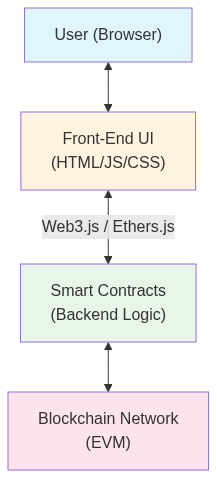
Decentralized Applications (DApps):
Definition:
A DApp (Decentralized Application) is a software application that runs on a decentralized network (blockchain) rather than centralized servers. It combines smart contracts (backend) with a user interface (frontend), operating without central control.
Key Characteristics:
1. Decentralized:
- Backend code runs on blockchain (peer-to-peer network)
- No single point of control or failure
- Data stored across distributed nodes
2. Open Source:
- Source code publicly available
- Changes require consensus
- Transparent operation
3. Incentivized:
- Uses cryptographic tokens
- Rewards validators/contributors
- Economic incentives align with network goals
4. Trustless:
- Users don't need to trust developers or operators
- Smart contracts enforce rules automatically
- Transparent and verifiable operations
5. Deterministic:
- Same inputs always produce same outputs
- Execution environment isolated (e.g., EVM)
- Predictable behavior
Differences from Traditional Apps:
| Aspect | Traditional App | DApp |
|---|---|---|
| Backend | Centralized servers | Blockchain (distributed) |
| Control | Company/owner | Community/protocol |
| Data | Central database | Distributed ledger |
| Downtime | Possible (server failure) | Near impossible (distributed) |
| Censorship | Easy (control owner has) | Difficult (no central control) |
| Trust | Required in operator | Placed in code/protocol |
| Updates | Unilateral by owner | Requires consensus |
Design of a DApp:
Architecture Layers:
flowchart TB
    subgraph Frontend["Frontend Layer (User Interface)"]
        A[Web Interface<br/>HTML/CSS/JavaScript]
        B[Mobile App<br/>iOS/Android]
        C[Desktop App]
    end

    subgraph Integration["Integration Layer"]
        D[Web3.js / Ethers.js]
        E[Wallet Connection<br/>MetaMask/WalletConnect]
    end

    subgraph Backend["Backend Layer (Smart Contracts)"]
        F[Smart Contracts<br/>Solidity/Rust]
        G[Business Logic]
    end

    subgraph Blockchain["Blockchain Layer"]
        H[Ethereum/Polygon/etc.]
        I[Distributed Ledger]
        J[Consensus Mechanism]
    end

    subgraph Storage["Storage Layer"]
        K[On-chain Storage<br/>Critical Data]
        L[Off-chain Storage<br/>IPFS/Arweave/Filecoin]
    end

    Frontend --> Integration
    Integration --> Backend
    Backend --> Blockchain
    Backend --> Storage
Detailed Component Design:
1. Frontend (Presentation Layer):
Purpose: User interface for interacting with DApp
Components:
Web Interface:
├─ HTML/CSS: Structure and styling
├─ JavaScript/TypeScript: Interactivity
├─ React/Vue/Angular: UI framework
├─ Web3 Libraries: Blockchain interaction
└─ Wallet Integration: User authentication

Technologies:
• React.js with Web3.js/Ethers.js
• Next.js for server-side rendering
• TailwindCSS for styling
• IPFS for hosting (decentralized)
Example Frontend Code:
import { ethers } from 'ethers';
import ContractABI from './ContractABI.json';

// Connect to wallet
async function connectWallet() {
    if (window.ethereum) {
        const provider = new ethers.providers.Web3Provider(window.ethereum);
        await provider.send("eth_requestAccounts", []);
        const signer = provider.getSigner();
        return signer;
    }
}

// Interact with smart contract
async function callContractFunction() {
    const signer = await connectWallet();
    const contractAddress = "0x123...";
    const contract = new ethers.Contract(contractAddress, ContractABI, signer);

    // Call function
    const tx = await contract.someFunction(param1, param2);
    await tx.wait(); // Wait for confirmation

    console.log("Transaction successful:", tx.hash);
}
2. Integration Layer:
Purpose: Bridge between frontend and blockchain
Key Libraries:
- Web3.js: Original Ethereum JavaScript library
- Ethers.js: Modern, lightweight alternative
- Wagmi: React hooks for Ethereum
- WalletConnect: Multi-wallet support
Wallet Integration:
// MetaMask connection
const connectMetaMask = async () => {
    try {
        const accounts = await window.ethereum.request({
            method: 'eth_requestAccounts'
        });
        setUserAddress(accounts[0]);
    } catch (error) {
        console.error("User rejected connection");
    }
};

// Read blockchain data
const getBalance = async (address) => {
    const provider = new ethers.providers.Web3Provider(window.ethereum);
    const balance = await provider.getBalance(address);
    return ethers.utils.formatEther(balance);
};

// Write to blockchain (transaction)
const sendTransaction = async (to, amount) => {
    const signer = provider.getSigner();
    const tx = await signer.sendTransaction({
        to: to,
        value: ethers.utils.parseEther(amount)
    });
    return tx;
};
3. Backend (Smart Contracts):
Purpose: Business logic and state management
Smart Contract Design:
// SPDX-License-Identifier: MIT
pragma solidity ^0.8.0;

contract DAppBackend {
    // State variables (stored on blockchain)
    mapping(address => uint256) public balances;
    address public owner;

    // Events (for frontend notifications)
    event Deposit(address indexed user, uint256 amount);
    event Withdrawal(address indexed user, uint256 amount);

    // Modifiers (access control)
    modifier onlyOwner() {
        require(msg.sender == owner, "Not authorized");
        _;
    }

    // Constructor
    constructor() {
        owner = msg.sender;
    }

    // Functions (business logic)
    function deposit() public payable {
        require(msg.value > 0, "Must send ETH");
        balances[msg.sender] += msg.value;
        emit Deposit(msg.sender, msg.value);
    }

    function withdraw(uint256 amount) public {
        require(balances[msg.sender] >= amount, "Insufficient balance");
        balances[msg.sender] -= amount;
        payable(msg.sender).transfer(amount);
        emit Withdrawal(msg.sender, amount);
    }

    function getBalance(address user) public view returns (uint256) {
        return balances[user];
    }
}
4. Storage Layer:
On-Chain Storage (Expensive):
Use for:
✓ Critical data (ownership, balances)
✓ Small data (hashes, addresses)
✓ Data requiring immutability guarantees

Avoid for:
✗ Large files (images, videos)
✗ Frequently changing data
✗ Non-critical metadata
Off-Chain Storage (Cost-Effective):
IPFS (InterPlanetary File System):
• Decentralized file storage
• Content-addressed (hash-based)
• No single point of failure
• Used for: Images, metadata, documents

Implementation:
1. Upload file to IPFS
2. Receive hash (e.g., QmX1234...)
3. Store hash on blockchain
4. Retrieve file using hash when needed
Example Storage Pattern:
contract NFTContract {
    struct NFT {
        uint256 tokenId;
        string ipfsHash; // Metadata on IPFS
        address owner;
    }

    mapping(uint256 => NFT) public tokens;

    function mintNFT(string memory ipfsHash) public {
        uint256 tokenId = totalSupply++;
        tokens[tokenId] = NFT(tokenId, ipfsHash, msg.sender);
        // Actual image/metadata on IPFS
        // Only hash stored on blockchain (cheap)
    }

    function getTokenMetadata(uint256 tokenId) public view returns (string memory) {
        return tokens[tokenId].ipfsHash;
        // Frontend fetches from IPFS using this hash
    }
}
5. Blockchain Layer:
Selection Criteria:
Ethereum:
✓ Most mature ecosystem
✓ Largest developer community
✓ High security
✗ High gas fees
✗ Lower throughput

Polygon/BSC:
✓ Lower fees
✓ Higher throughput
✓ Ethereum-compatible
✗ More centralized

Solana:
✓ Very fast
✓ Low fees
✗ Different dev stack (Rust)
✗ Less mature

Avalanche:
✓ Fast finality
✓ EVM-compatible
✓ Subnet customization
✗ Smaller ecosystem
DApp Design Patterns:
1. Oracle Pattern (External Data):
contract PriceFeed {
    address public oracle;
    uint256 public price;

    modifier onlyOracle() {
        require(msg.sender == oracle, "Not oracle");
        _;
    }

    function updatePrice(uint256 _price) public onlyOracle {
        price = _price;
    }
}
2. Access Control Pattern:
contract AccessControl {
    mapping(address => bool) public admins;

    modifier onlyAdmin() {
        require(admins[msg.sender], "Not admin");
        _;
    }

    function addAdmin(address _admin) public onlyAdmin {
        admins[_admin] = true;
    }
}
3. Upgradeable Contract Pattern (Proxy):
contract Proxy {
    address public implementation;

    function upgradeTo(address newImplementation) public {
        implementation = newImplementation;
    }

    fallback() external payable {
        address impl = implementation;
        assembly {
            // Delegate call to implementation
            calldatacopy(0, 0, calldatasize())
            let result := delegatecall(gas(), impl, 0, calldatasize(), 0, 0)
            returndatacopy(0, 0, returndatasize())
            switch result
            case 0 { revert(0, returndatasize()) }
            default { return(0, returndatasize()) }
        }
    }
}
Complete DApp Workflow:
User Journey:
1. User visits DApp website (hosted on IPFS/traditional hosting)
2. Connects wallet (MetaMask prompts user)
3. Interacts with UI (clicks button, fills form)
4. Frontend calls Web3 library
5. Library creates transaction and sends to wallet
6. User confirms transaction in wallet
7. Transaction broadcast to blockchain
8. Smart contract executes
9. State changes on blockchain
10. Event emitted
11. Frontend listens for event
12. UI updates to reflect new state
Example: Decentralized Voting DApp:
Architecture:
Frontend: React app showing proposals and voting interface
Smart Contract: Stores proposals, tracks votes, prevents double-voting
Storage: Proposal details on IPFS, hashes on blockchain
Blockchain: Ethereum (immutable vote records)

User Flow:
1. Admin creates proposal (writes to blockchain)
2. Proposal data stored on IPFS
3. IPFS hash stored in smart contract
4. Users see proposals (read from blockchain + IPFS)
5. User votes (transaction sent to smart contract)
6. Smart contract validates (hasn't voted, eligible)
7. Vote recorded on blockchain
8. Event emitted
9. UI updates vote count
10. Results visible to all (transparent)
Best Practices:
- Security: Audit smart contracts, use established patterns
- Gas Optimization: Minimize on-chain storage, batch operations
- User Experience: Handle wallet connection gracefully, show transaction status
- Modularity: Separate concerns (frontend, backend, storage)
- Testing: Extensive testing before mainnet deployment
- Documentation: Clear instructions for users and developers
Popular DApp Examples:
- Uniswap: Decentralized exchange (DeFi)
- OpenSea: NFT marketplace
- Aave: Lending/borrowing protocol
- Decentraland: Virtual world
- Compound: Money market protocol
Conclusion:
DApp design combines:
- Frontend: Familiar web technologies with blockchain integration
- Backend: Smart contracts replacing traditional servers
- Storage: Hybrid on-chain (critical) and off-chain (bulk) data
- Blockchain: Immutable, decentralized infrastructure
This architecture creates applications that are transparent, censorship-resistant, and operate without central control, representing a fundamental shift in how software is built and operated.
(b) Explain how blockchain technology can impact the health care sector? (7 marks)
Blockchain Impact on Healthcare:
Blockchain technology addresses critical challenges in healthcare including data interoperability, security, privacy, and patient empowerment. Its immutable, transparent, and decentralized nature makes it particularly suited for medical applications.
Major Impact Areas:
1. Electronic Health Records (EHR) Management:
Current Problems:
- Data silos (each hospital has separate system)
- Lack of interoperability
- Difficult to access complete medical history
- Duplication of tests
- Data loss during transitions
Blockchain Solution:
Architecture:
┌─────────────┐     ┌─────────────┐     ┌─────────────┐
│  Hospital A │     │  Hospital B │     │  Clinic C   │
│  Local EHR  │     │  Local EHR  │     │  Local EHR  │
└──────┬──────┘     └──────┬──────┘     └──────┬──────┘
       │                   │                   │
       │    References stored on blockchain    │
       └───────────────────┼───────────────────┘
                           │
              ┌────────────▼──────────┐
              │    Blockchain         │
              │  ┌─────────────────┐ │
              │  │ Patient Record  │ │
              │  │ - Pointer to    │ │
              │  │   Hospital A    │ │
              │  │ - Pointer to    │ │
              │  │   Hospital B    │ │
              │  │ - Access Log    │ │
              │  │ - Permissions   │ │
              │  └─────────────────┘ │
              └─────────────────────┘
                      │
              Actual data on IPFS/
              encrypted off-chain storage
Implementation:
contract MedicalRecords {
    struct Record {
        bytes32 recordHash; // IPFS hash of encrypted record
        address provider; // Hospital/doctor who created
        uint256 timestamp;
        string recordType; // "Lab", "Imaging", "Prescription"
    }

    mapping(address => Record[]) public patientRecords;
    mapping(address => mapping(address => bool)) public accessPermissions;

    event RecordAdded(address indexed patient, bytes32 recordHash, address provider);
    event AccessGranted(address indexed patient, address indexed provider);
    event AccessRevoked(address indexed patient, address indexed provider);

    // Patient adds new record
    function addRecord(bytes32 _recordHash, string memory _recordType) public {
        Record memory newRecord = Record({
            recordHash: _recordHash,
            provider: msg.sender,
            timestamp: block.timestamp,
            recordType: _recordType
        });
        patientRecords[msg.sender].push(newRecord);
        emit RecordAdded(msg.sender, _recordHash, msg.sender);
    }

    // Patient grants access to doctor/hospital
    function grantAccess(address provider) public {
        accessPermissions[msg.sender][provider] = true;
        emit AccessGranted(msg.sender, provider);
    }

    // Patient revokes access
    function revokeAccess(address provider) public {
        accessPermissions[msg.sender][provider] = false;
        emit AccessRevoked(msg.sender, provider);
    }

    // Provider retrieves patient records (if authorized)
    function getRecords(address patient) public view returns (Record[] memory) {
        require(
            accessPermissions[patient][msg.sender] || msg.sender == patient,
            "Not authorized"
        );
        return patientRecords[patient];
    }
}
Benefits:
- Patient Control: Patients own and control access to their data
- Interoperability: All providers access same unified record
- Completeness: Full medical history available
- Efficiency: Reduced duplicate tests, better diagnoses
- Portability: Easy to switch providers
2. Drug Supply Chain and Anti-Counterfeiting:
Problem:
- $200 billion annual cost from counterfeit drugs
- Difficult to trace drug origin
- Lack of transparency in supply chain
- Patient safety risks
Blockchain Solution:
Track and Trace System:
Manufacturer → Distributor → Wholesaler → Pharmacy → Patient
      ↓            ↓             ↓            ↓          ↓
    Block 1     Block 2      Block 3      Block 4   Block 5
Each block records:
Drug Batch #12345:
├─ Manufacturer: PharmaCorp (verified address)
├─ Manufacturing Date: 2024-01-15
├─ Expiration: 2026-01-15
├─ Ingredients: [verified hashes]
├─ Quality Tests: Pass (hash of certificates)
├─ Current Location: GPS coordinates
├─ Temperature Log: [encrypted sensor data]
├─ Chain of Custody: All transfers recorded
└─ Patient can verify: Scan QR code → See full history
Smart Contract for Verification:
contract DrugSupplyChain {
    struct Drug {
        string batchNumber;
        address manufacturer;
        uint256 mfgDate;
        uint256 expDate;
        string currentLocation;
    }

    mapping(string => Drug) public drugs;
    mapping(string => address[]) public chainOfCustody;

    event DrugManufactured(string batchNumber, address manufacturer);
    event DrugTransferred(string batchNumber, address from, address to);

    function manufactureDrug(
        string memory batchNumber,
        uint256 mfgDate,
        uint256 expDate
    ) public {
        drugs[batchNumber] = Drug(batchNumber, msg.sender, mfgDate, expDate, "Manufacturer");
        chainOfCustody[batchNumber].push(msg.sender);
        emit DrugManufactured(batchNumber, msg.sender);
    }

    function transferDrug(string memory batchNumber, address to) public {
        require(drugs[batchNumber].manufacturer != address(0), "Drug not found");
        chainOfCustody[batchNumber].push(to);
        emit DrugTransferred(batchNumber, msg.sender, to);
    }

    function verifyDrug(string memory batchNumber) public view returns (
        address manufacturer,
        uint256 mfgDate,
        uint256 expDate,
        bool isAuthentic
    ) {
        Drug memory drug = drugs[batchNumber];
        return (
            drug.manufacturer,
            drug.mfgDate,
            drug.expDate,
            drug.manufacturer != address(0)
        );
    }
}
Benefits:
- Authenticity: Patients verify drug legitimacy
- Safety: Immediate recall of contaminated batches
- Compliance: Automated regulatory reporting
- Transparency: Full visibility into supply chain
3. Clinical Trials and Research:
Challenges:
- Data fraud and manipulation
- Patient recruitment difficulties
- Lack of data sharing
- Informed consent tracking
Blockchain Solution:
Trial Data Integrity:
Clinical Trial Process on Blockchain:

1. Trial Registration:
   └─ Protocol registered on blockchain (immutable)

2. Patient Enrollment:
   └─ Informed consent recorded (timestamped, signed)

3. Data Collection:
   └─ Each data point hashed and stored
   └─ Cannot retroactively change results

4. Results Publication:
   └─ Transparent, verifiable outcomes
   └─ No selective reporting
Consent Management:
contract ClinicalTrialConsent {
    struct Consent {
        address patient;
        string studyId;
        bool consentGiven;
        uint256 timestamp;
        string consentFormHash; // IPFS hash
    }

    mapping(address => mapping(string => Consent)) public consents;

    event ConsentGiven(address indexed patient, string studyId, uint256 timestamp);
    event ConsentRevoked(address indexed patient, string studyId);

    function giveConsent(string memory studyId, string memory consentFormHash) public {
        consents[msg.sender][studyId] = Consent({
            patient: msg.sender,
            studyId: studyId,
            consentGiven: true,
            timestamp: block.timestamp,
            consentFormHash: consentFormHash
        });
        emit ConsentGiven(msg.sender, studyId, block.timestamp);
    }

    function revokeConsent(string memory studyId) public {
        consents[msg.sender][studyId].consentGiven = false;
        emit ConsentRevoked(msg.sender, studyId);
    }

    function hasConsent(address patient, string memory studyId) public view returns (bool) {
        return consents[patient][studyId].consentGiven;
    }
}
Benefits:
- Data Integrity: Tamper-proof trial results
- Transparency: All stakeholders see same data
- Patient Rights: Easy consent management
- Collaboration: Secure data sharing between institutions
4. Medical Credentials and Licensing:
Problem:
- Credential fraud
- Manual verification processes
- Difficulty tracking continuing education
- Cross-border verification challenges
Blockchain Solution:
Credential Registry:
Doctor Profile on Blockchain:
├─ Medical Degree: [University, Date, Hash of Diploma]
├─ Licenses: [State Medical Board, License #, Expiration]
├─ Specializations: [Board Certifications]
├─ Continuing Education: [Courses, Credits, Dates]
├─ Employment History: [Verified by hospitals]
├─ Disciplinary Actions: [Transparent, immutable]
└─ Publicly Verifiable: Anyone can check credentials
Benefits:
- Instant Verification: Employers verify instantly
- Fraud Prevention: Fake credentials eliminated
- Portability: Credentials valid across borders
- Transparency: Patients verify doctor credentials
5. Insurance Claims Processing:
Current Issues:
- Slow processing (weeks/months)
- High administrative costs
- Fraud ($68 billion annually in US)
- Disputes and denials
Blockchain + Smart Contracts:
Automated Claims:
contract HealthInsuranceClaims {
    struct Policy {
        address policyHolder;
        uint256 coverage;
        uint256 premium;
        bool active;
    }

    struct Claim {
        uint256 amount;
        string treatmentHash; // IPFS hash of treatment details
        bool approved;
        bool paid;
    }

    mapping(address => Policy) public policies;
    mapping(uint256 => Claim) public claims;
    uint256 public claimCounter;

    event ClaimSubmitted(uint256 claimId, address indexed patient, uint256 amount);
    event ClaimApproved(uint256 claimId, uint256 amount);
    event ClaimPaid(uint256 claimId, uint256 amount);

    function submitClaim(uint256 amount, string memory treatmentHash) public {
        require(policies[msg.sender].active, "No active policy");
        require(amount <= policies[msg.sender].coverage, "Exceeds coverage");

        claims[claimCounter] = Claim(amount, treatmentHash, false, false);
        emit ClaimSubmitted(claimCounter, msg.sender, amount);
        claimCounter++;

        // Automatic approval for eligible claims
        if (isEligible(amount, treatmentHash)) {
            approveClaim(claimCounter - 1);
        }
    }

    function approveClaim(uint256 claimId) internal {
        claims[claimId].approved = true;
        emit ClaimApproved(claimId, claims[claimId].amount);

        // Automatic payment
        payClaim(claimId);
    }

    function payClaim(uint256 claimId) internal {
        require(claims[claimId].approved, "Claim not approved");
        claims[claimId].paid = true;
        // Transfer funds to patient
        emit ClaimPaid(claimId, claims[claimId].amount);
    }

    function isEligible(uint256 amount, string memory treatmentHash) internal pure returns (bool) {
        // Logic to verify eligibility based on policy terms
        // Could integrate with oracles for medical codes, etc.
        return true; // Simplified
    }
}
Benefits:
- Speed: Instant/automatic processing
- Transparency: All parties see same information
- Fraud Reduction: Immutable records prevent duplicate claims
- Cost Savings: Reduced administrative overhead
6. IoT and Remote Patient Monitoring:
Use Case:
- Wearable devices collect health data
- Data stored on blockchain
- Doctors access real-time health metrics
- Insurance incentives for healthy behavior
Architecture:
Wearable Device (Heart Rate, Activity, etc.)
         ↓
    IoT Gateway
         ↓
   Blockchain (stores hashes, timestamps)
         ↓
    IPFS (stores actual data, encrypted)
         ↓
Authorized Parties (doctors, patient, insurance)
Benefits:
- Continuous Monitoring: Real-time health tracking
- Data Integrity: Devices can't falsify data
- Privacy: Patient controls access
- Incentives: Automated rewards for healthy behaviors
Real-World Implementations:
- MedRec (MIT): EHR management on blockchain
- Guardtime: Estonian national health records on blockchain
- Chronicled: Pharmaceutical supply chain tracking
- Solve.Care: Healthcare administration platform
- Patientory: Patient-centered health information exchange
Challenges and Solutions:
| Challenge | Solution |
|---|---|
| Scalability | Layer 2 solutions, off-chain storage (IPFS) |
| Privacy (HIPAA/GDPR) | Encryption, zero-knowledge proofs, permissioned blockchains |
| Interoperability | Standardized APIs, cross-chain protocols |
| Adoption | Education, pilot programs, regulatory support |
| Cost | Choose appropriate blockchain (public vs private) |
Future Impact:
Short Term:
- Pilot projects in drug traceability
- Blockchain-based credential verification
- Limited EHR interoperability solutions
Medium Term:
- Widespread EHR on blockchain
- Automated insurance claims
- Global clinical trial data sharing
Long Term:
- Patient-owned health data economy
- AI-driven personalized medicine using blockchain data
- Global, interoperable health records
Conclusion:
Blockchain transforms healthcare by:
- Empowering Patients: Data ownership and access control
- Improving Security: Tamper-proof, encrypted records
- Enabling Interoperability: Universal data access
- Reducing Fraud: Transparent, verifiable supply chains and claims
- Accelerating Research: Secure data sharing for clinical trials
- Lowering Costs: Automated processes, reduced intermediaries
The technology addresses fundamental healthcare challenges while respecting privacy, security, and patient rights - promising a more efficient, transparent, and patient-centric healthcare system.